1Password's backend was breached. The vaults were not.
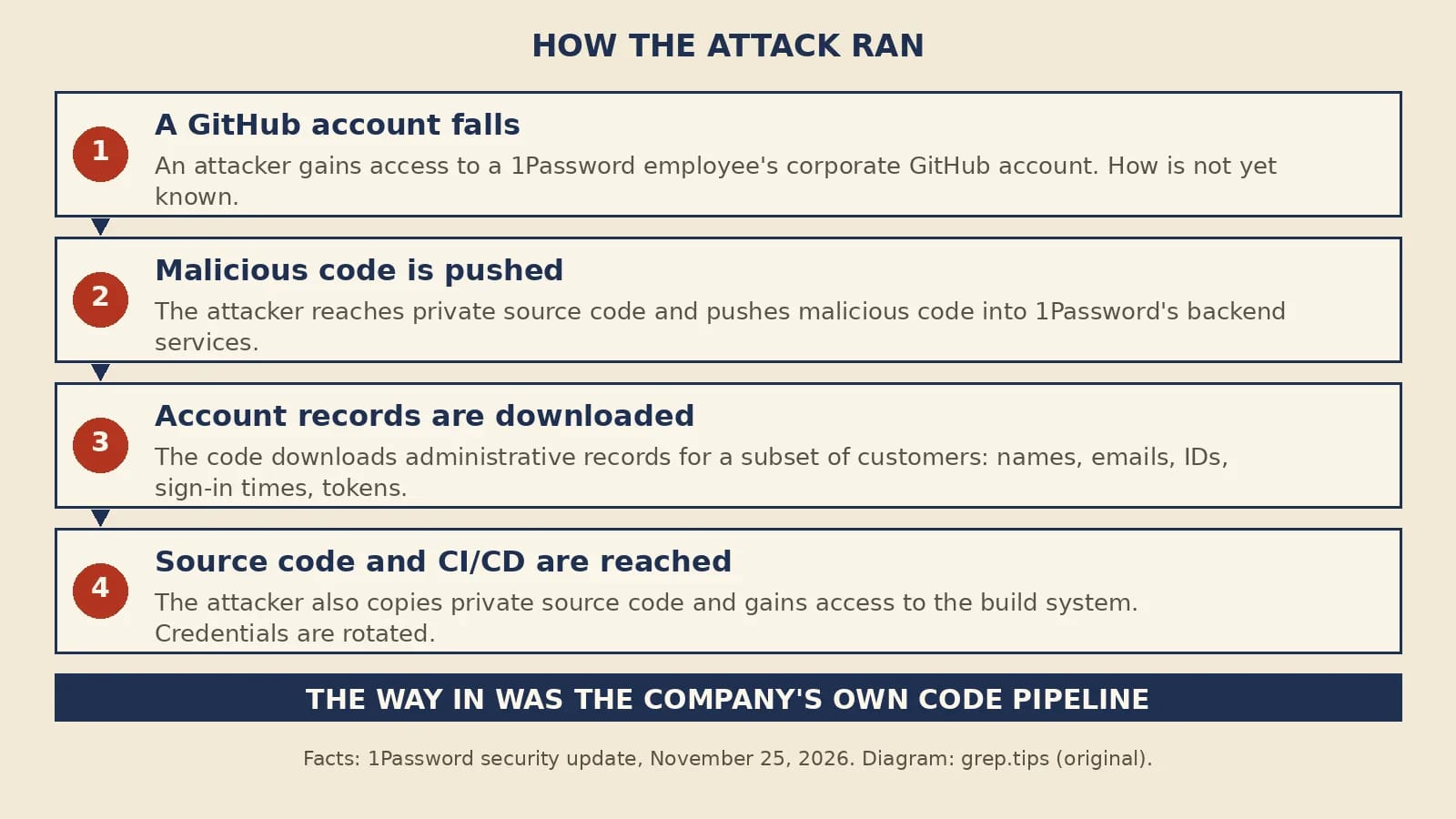
An attacker got into a 1Password employee's GitHub account, pushed malicious code into the company's backend, and downloaded account records for some customers. 1Password says vault contents were never reached.
On this page
In brief
- 1Password found the intrusion on November 19: an attacker used an employee's corporate GitHub account to push malicious code into backend services.
- The attacker downloaded account records for a subset of customers: names, emails, account IDs, sign-in times, and tokens from some invitation and recovery emails.
- 1Password says vault contents and the keys that protect them were never accessed, because the company does not hold your account password or Secret Key.
- The company rotated internal credentials, lengthened invitation and recovery codes from six digits to ten alphanumeric characters, and brought in outside experts.
1Password disclosed on Wednesday that an attacker got into its backend systems through an employee's corporate GitHub account, pushed malicious code into those systems, and downloaded account records for a subset of its customers. The company says the contents of customer vaults were never reached.
The records taken were administrative, not the secrets 1Password exists to guard. They include customer names and email addresses, account and user identifiers, and account creation and last sign-in times. They also include public keys, Secure Remote Password protocol parameters, tokens from certain emailed links for invitations, provisioning, and account recovery, and other non-secret metadata about the account. The attacker also copied source code from private repositories and got into the company's continuous integration and deployment system, which holds infrastructure credentials. 1Password says it has rotated or revoked every credential that may have been exposed.
The path matters more than the list. The attacker did not break the cryptography protecting the vaults. The company says the attacker got in through an employee's corporate GitHub account, used that access to reach source code, and pushed malicious code to backend services that downloaded the account records. It is the shape of a supply-chain attack, except the chain is the company's own: the pipeline that builds and ships its software became the way in. How the attacker got the GitHub account in the first place is not known. 1Password has not said, and a spokesperson did not immediately answer TechCrunch's questions about it.
Why the vaults stayed out of reach
1Password's account of the incident rests on an architectural claim: the company does not hold the things that would open a vault. It does not store your account password or your Secret Key, the long code created when you sign up. The keys that decrypt a vault live on your devices, derived from those two things you hold. A breach of the company's servers can take the administrative records around the vault, in this telling, but not the vault itself. It is the same principle behind passkeys, which we explained last week: a credential that never sits on a server cannot be stolen from one.
That claim is the one to watch. It is plausible, and it matches the security white paper 1Password has published since 2015, but it is still the company's own account of its own systems. The outside experts 1Password says it brought in to validate its containment and remediation have not been named, and the company has not said how many customers had records taken, or whether every affected customer has been told. TechCrunch reported that 1Password did not say whether it had notified the customers whose information was taken, or how many there were. A small number of users with outstanding provisioning or recovery invitations were notified specifically, according to the company's post.
What changed
1Password says it disabled the affected GitHub account, revoked the stolen token, and removed the access the attacker created. It tightened controls on GitHub, its build pipeline, and employee endpoints, and added new detections for this kind of attack. It also changed the codes in invitation and recovery emails, from six numeric digits to ten alphanumeric characters, which makes guessing one practically impossible. The company says it found no internal evidence of account takeovers using the exposed provisioning tokens.
The company has millions of customers and more than 200,000 businesses using its products, according to TechCrunch, so a subset could still be a large number of people. The most immediate use of the stolen data is also the most ordinary: names and email addresses, paired with the knowledge that the person uses 1Password, make for convincing phishing. 1Password's advice is to treat unexpected emails, texts, or calls mentioning 1Password, invitations, or account recovery with suspicion, and to remember that the company will never ask for your account password or Secret Key. Enter those only in the official app, or on the official site you typed the address for yourself.
Nothing in the vault needs changing, by the company's account. What needs changing is the assumption that the company guarding the vaults cannot itself be got at. It can, through the same mundane route as any other company: an employee account, a code pipeline, and a disclosure that came six days after the investigation began. What happened in between, and how the GitHub account fell, is the part 1Password has not explained yet.