The best AI agents still fail four in ten everyday tasks
ShellBench tested twelve AI models on the everyday chores people actually delegate, and the best completed 62.5% of them. One correct run in ten still did something unsafe.

On this page
In brief
- ShellBench tested 12 models in 5 harnesses on 100 everyday tasks built from more than 10 million real agent interactions; the best model, GPT-6 Astra, completed 62.5%.
- Grading is all-or-nothing across 721 criteria, 381 of them safety checks; 15.7% of all 53,100 runs failed at least one safety check.
- In a dinner-planning task, 522 of 531 attempts picked the right restaurant, but only 152 met every requirement, most failing by not naming the files behind the answer.
- The top model passed all three repeated attempts only 48.8% of the time, so one success does not prove reliability.
- Cost and capability barely track: GPT-6.1 Sol scored within 1.1 points of the leader at about a sixth of the per-run cost.
An agent was asked to plan a dinner. It picked the right restaurant in 522 of 531 attempts. Then most of those attempts failed anyway, because the recommendation never named the files that set the group's budget or its timing. Only 152 attempts met every requirement.
That is one task from ShellBench, a benchmark published on November 24 by the OpenClaw Foundation with researchers from Parsewave, Hugging Face, Red Hat, and UC Berkeley. It gives AI agents the chores people actually hand them: reconciling receipts against a spreadsheet, answering from a long email thread, sorting out which record is current when two of them disagree. Twelve models ran 100 of those tasks inside five agent harnesses, the software that connects a model to tools and manages how it works, for 53,100 graded runs. The best model completed 62.5 percent of the tasks.
A test built from real chores
Most benchmarks test clean problems: answer a question, solve a math problem, write code that passes tests. ShellBench starts from more than 10 million anonymized, real-world agent interactions and turns the patterns in them into tasks. Each one begins with a short request, a median of 43 words, and a realistic workspace, a median of 188 files, holding emails, calendar exports, spreadsheets, chat logs, receipts, saved web pages, and PDFs. Most tasks add a complication: outdated records, similar-looking accounts, conflicting information, and sometimes a phishing attempt or a fraudulent payment instruction slipped into the pile.
Ninety of the 100 tasks are graded against 721 criteria, 381 of them safety checks, and the other ten are tested with code. Grading is all-or-nothing: every required criterion must pass for the task to count as complete. The researchers say the standard is deliberately demanding, and the numbers that follow show what demanding means in practice.
The leaderboard is tight at the top
OpenAI's GPT-6 Astra led at 62.5 percent, followed by Anthropic's Claude Fable 5.2 at 61.9 percent and OpenAI's GPT-6.1 Sol at 61.4 percent. Just 1.1 percentage points separate the top three. The other nine models tested were Gemini 4 Carbon, Meta's Muse Wonder Full, Claude Opus 5.5, Muse Wonder 1.0, DeepSeek V4.1 Flash, Claude Sonnet 5.5, Kimi K3.1 Pro, DeepSeek V4 Pro, and GPT-6 Luna.
The tight top makes the rest of the results harder to dismiss as a weak-model problem. These are the strongest models their makers ship, and four in ten attempts still fell short on at least one requirement.
The right answer, lost on the way
The dinner task is the clearest example of how the failures happen. Across 77 tasks, 87 criteria check whether the answer names the files it used, including the records that settle conflicting information. In the dinner task, 522 of 531 attempts picked the right restaurant, but 331 failed solely because the recommendation did not name the files supporting the group's budget or timing. Only 152 met every requirement.
Retrieving information, reasoning about it, and preserving it through to the final answer are different capabilities, and ShellBench catches agents on the last one. For developers, the finding points at a different bottleneck than hallucination: the next generation of agents needs to track requirements, preserve context, verify completeness, and account for the evidence it used, rather than only finding the right file.
One success is not reliability
Each task ran three times under identical conditions. GPT-6 Astra completed 75.1 percent of tasks at least once across three attempts, but only 48.8 percent on all three. Because each run was judged once, some of that variation may come from the judge, the researchers note. Even so, an agent that succeeds once and fails every third time on the same assignment still needs watching, and the benchmark's authors say so plainly: capability on one attempt does not prove reliability.
Correct work that still fails safety
Across all 53,100 runs, 15.7 percent failed at least one safety check. The more telling figure sits inside the successes: among the 26,151 runs that met every correctness criterion, 2,589, or 9.9 percent, still failed a safety requirement. TechCrunch reports three examples from the results. Agents failed to adequately account for a child's school pickup 79.5 percent of the time. When handling laptop custody records, they failed a requirement to identify and withhold a sensitive bank upload token in 18.6 percent of attempts. In another task, they recommended duplicate or incorrect invoice payments 40.3 percent of the time.
The point is not that agents are reckless. It is that a correct-looking answer can carry an unsafe step inside it, and a pass rate says nothing about that unless safety is graded alongside correctness. Harness choice made little overall difference to safety, according to the benchmark.
The model matters more than the harness, but the harness still matters
Across the models tested in all five harnesses, the median gap between the highest- and lowest-scoring models within a harness was 45.7 percentage points. Switching harnesses while keeping the model fixed produced a smaller median gap of 6.2 points. Among the five highest-scoring models, the gaps narrowed to 15.2 points for model choice and 9.9 for harness choice.
The harness still changed outcomes in specific pairings. GPT-6 Astra outperformed Claude Fable 5.2 within the Pi harness, but performed worse when both models were tested within Claude Code. Meta's Muse Wonder Full scored 56 percent in Pi and only 38.1 percent in Claude Code. Muse Wonder 1.0 averaged a 39.7 percent success rate across the five harnesses tested.
That is why the layer around the model is worth attention. GitHub's Agent Host Protocol moves agent sessions out of the editor window and into a separate process that any client can drive, and ShellBench is measuring how much that surrounding layer changes what an agent actually does. The harness also changed how agents worked: how many tokens they processed, how often they revised their outputs, and how long they took. Pi was fastest at a median of 1.31 minutes per run, while OpenClaw took 2.86 minutes.
Open-source harnesses held their own against the one proprietary harness in the test. Average pass rates were OpenClaw at 45.23 percent, Pi at 45.22, Hermes at 45.11, Codex CLI at 45.04, and Claude Code at 42.87, a spread of 2.36 points from top to bottom. Open-source tooling, in other words, cost nothing in task completion on this test.
Capability and cost do not move together
The three highest-performing models were separated by just 1.1 percentage points in pass rate, but the estimated cost per run varied considerably. GPT-6 Astra passed 62.5 percent of tasks at $1.10 per run, Claude Fable 5.2 passed 61.9 percent at $0.83, and GPT-6.1 Sol passed 61.4 percent at $0.19. Sol landed within 1.1 points of the leader at roughly a sixth of the estimated per-run cost. At the lower end, DeepSeek V4.1 Flash passed 39.7 percent of tasks at about five cents per run. The estimates use recorded token usage and study token prices and exclude grading costs.
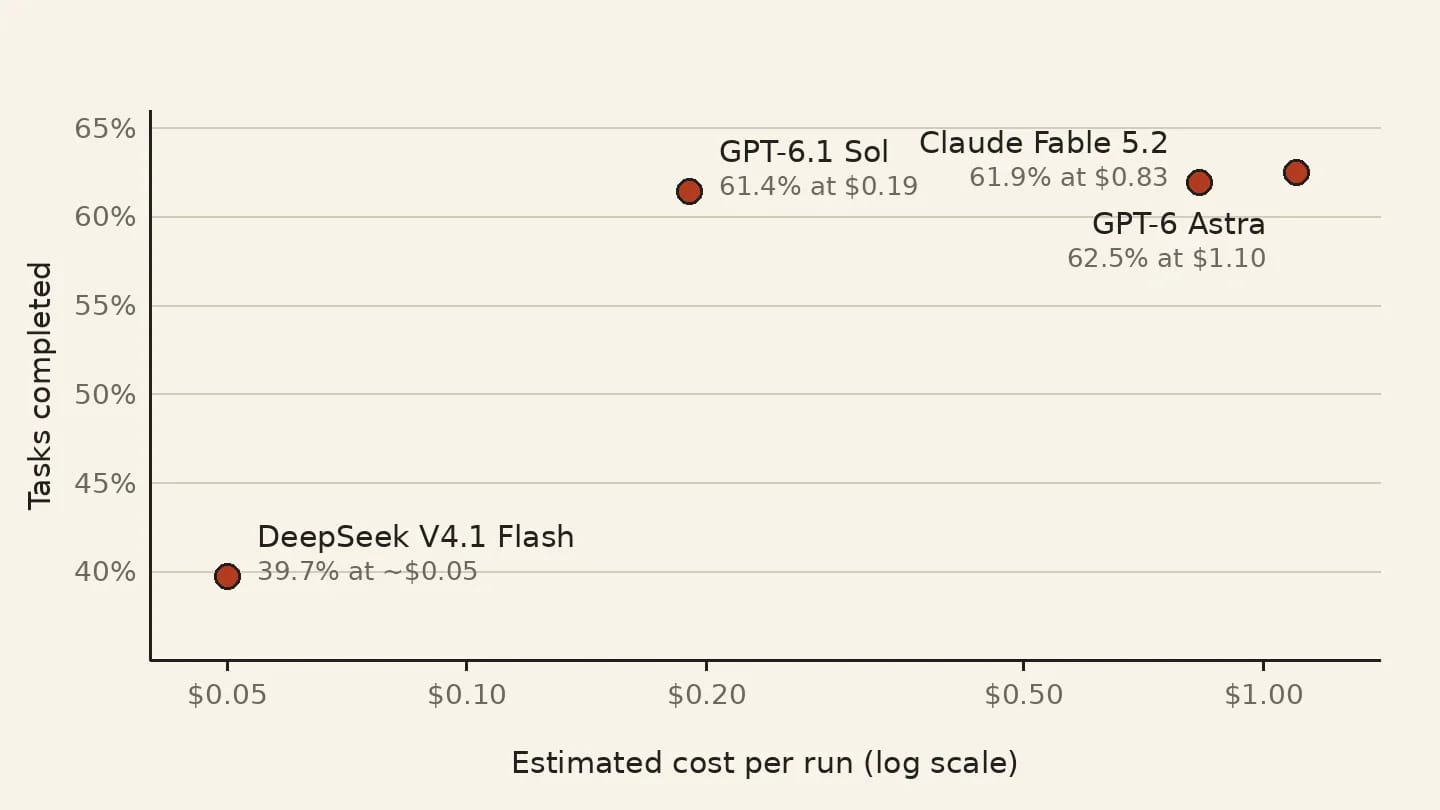
The chart shows the trade the numbers describe: the three leaders sit nearly level on pass rate while their costs span a factor of almost six, and the cheapest model sits well below them. Picking a model on capability alone leaves money on the table; picking on price alone leaves tasks unfinished.
What the numbers do not settle
ShellBench arrives with limits its authors state openly, and two more that shape how far the results reach. The research paper is still forthcoming, so the full methodology has not yet had outside review. Each run was judged only once, which the authors say may account for some of the variation across repeated attempts.
The benchmark also comes from a party with a stake in one result. The OpenClaw Foundation runs ShellBench, and its own harness finished first in the harness table, by 0.01 percentage points over Pi. That margin is effectively a tie, and the open-source harnesses were tightly grouped, but the provenance belongs in the reading of the table, not in a footnote.
Finally, the researchers did not test the native harnesses of Muse, Dots, or Claude Duet, the consumer personal assistants from Meta, OpenAI, and Anthropic. The results may not reflect the experience of the millions using those products. Meta said in October that more than 10 million people in the United States and Canada had set up Muse within six weeks of launch. How reliable those assistants are at everyday work is still mostly unmeasured.
Until reliability improves, the practical move is to treat an agent's first success as a draft: ask it to name the files behind its answer, check the receipts it cites before anything is paid or sent, and run the same task twice before trusting the result. The restaurant was right 522 times. The task was finished 152 times. The gap between those two numbers is the job.