Shirudo: OpenAI and Cisco's AI-written shield for the days before a patch lands
OpenAI and Cisco open-sourced Shirudo, a Linux runtime where AI agents write small signed shields that block exploits on running systems while the real patch is still in testing.
On this page
In brief
- OpenAI and Cisco launched Shirudo on November 23, an open-source Linux runtime that deploys small, temporary shields against known flaws while the real patch is still being prepared.
- A shield is an eBPF program or Java bytecode written by an AI agent, checked against the exploit, and approved by an operator before it blocks anything.
- In a controlled test, a Codex-written shield blocked a Java4Shell exploit on a running Elasticsearch 9.5.5 service without a restart.
- Shields are cryptographically signed, verified by the kernel and TPM hardware, and retire when the real patch lands; the project is pre-release and needs a patched kernel and TPM 2.0.
A security patch takes days to test and roll out. An exploit now takes hours to build, and sometimes less. On November 23, OpenAI and Cisco announced a tool built for the gap between those two numbers.
Shirudo, Japanese for "shield," is an open-source runtime for Linux that lets an AI agent write a small, targeted block against a known flaw and load it onto a running system, with no restart and no wait for the vendor's fix. The block, called a shield, is temporary: it retires when the real patch lands.
Why the gap exists
Testing a fix, rolling it out across a fleet, and restarting the services it touches takes days or weeks. The attack side no longer waits that long: Cisco notes exploit campaigns for the recent PHP flaw and Java4Shell were underway within a day of disclosure, if not before. Isovalent, Cisco's eBPF team and Shirudo's co-developer, puts it more bluntly: the mean time to exploitation has become negative, with a growing number of flaws exploited before they are publicly disclosed.
Google's threat researchers documented the same collapse earlier in November: an agent framework that diffs patches, finds the flaw each fix addresses, and fires off exploits with no human in the loop. When the patch itself becomes the instruction manual, the days between disclosure and deployment stop being a grace period.
Shirudo is built for that window: not a replacement for the patch, but something to put in the hole while it is being prepared.
What a shield is
A shield is a small program that blocks one specific malicious behavior and leaves everything else alone. Shirudo supports two kinds: an eBPF program, which runs inside the Linux kernel at a chosen hook point. The kernel's verifier checks it against its safety rules before it runs, so a bad shield cannot crash the system it is meant to protect. The second kind is Java bytecode, injected into a running application, for flaws that live in the application or its runtime rather than the kernel.
The worked example is Java4Shell, the OpenJDK Base64 flaw disclosed on November 17: a 65-character input overflows the hardware-accelerated decoder, and its finders demonstrated remote code execution against unpatched Java servers. Rather than patching the decoder, the shield adds an input check to it: the malicious input is rejected, the legitimate input passes through, and the application keeps running.
In the controlled test Isovalent describes, OpenAI's Codex wrote that shield and attached it to a running Elasticsearch 9.5.5 service. The exploit attempt failed, the service stayed up, and the blocked attempt showed in the logs. Cisco says the same approach produced a shield for the recent PHP flaw, which reportedly affected an estimated 70 percent of global websites.
Both flaws were found by the security firm Calif using OpenAI's Cyber model; Calif says Java4Shell took about three hours to find and exploit, for under 200 dollars in tokens. Discovery already runs at machine speed. Shirudo is the defense side catching up.
The chain of trust
Letting an AI agent write code that runs in the kernel or inside a Java process is an obvious trust problem, and most of Shirudo's design answers it. The shield travels through a chain in which every handoff is signed and recorded.
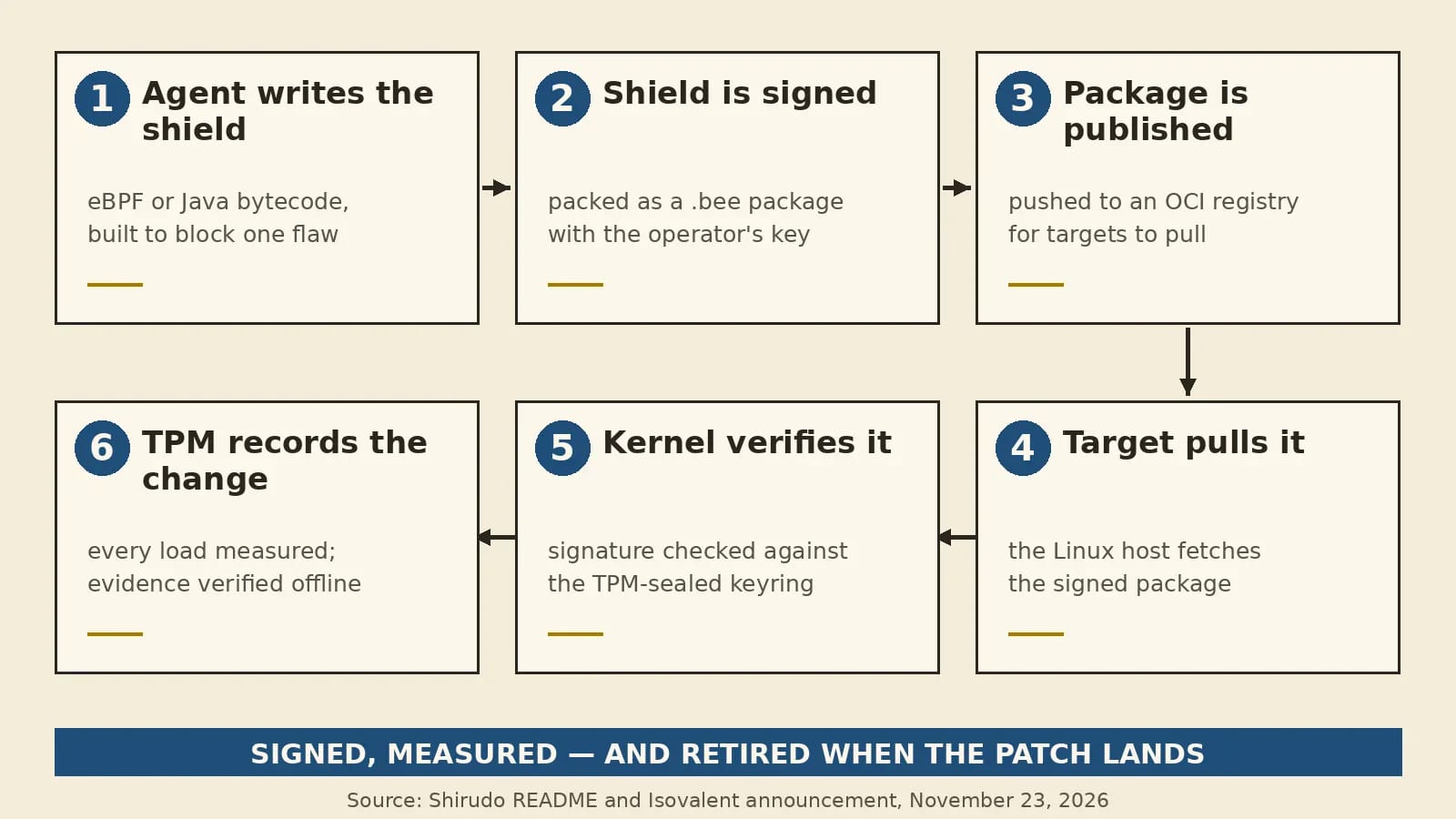
An agent on the operator's machine builds the shield, reproduces the exploit, and checks that the shield blocks it while the service still runs. The shield is then signed, packed as a .bee package, pushed to an OCI registry — the standard format for container images — and pulled by each target. Before anything runs, the kernel verifies the signature against a sealed keyring, and a Trusted Platform Module records every load and unload in a hardware register the operator can verify offline.
Two properties matter most. The shield only graduates to active blocking when the evidence says it is safe; until then, a team can watch its effect on the application. And Shirudo itself does not judge whether a shield is a good idea. As the project's documentation puts it, the platform does not understand what a shield does; it makes sure only signed shields run and every change is on record. Judgment stays with the operator.
The chain has a stated limit: Shirudo's documentation warns that a kernel bug giving an attacker code execution bypasses every check the platform makes, because nothing inside the kernel can police the kernel once an attacker controls it. A shield is one layer, not a substitute for the layers beneath it.
Why agents, and why code
Shirudo has its roots in Tetragon, Isovalent's eBPF-based platform from 2022, which also powers Cisco's Live Protect mitigation. But Shirudo is a rewrite, not a port, and the reason is the agent.
Early attempts at agent-driven defense pointed agents at interfaces built for humans: consoles, configuration files, policy languages. Isovalent's argument is that those abstractions constrain agents more than they help them. An agent is good at generating code and can absorb large amounts of context quickly, including, in Isovalent's words, reverse engineering several million lines of assembly. So Shirudo lets the agent work in its own language: code. The shield is a small program, written in BPF C or Java bytecode, that an engineer or an agent can read, generate, and maintain.
The loop is deliberately mechanical: scan code or take in a disclosure, trace the flaw to the affected assets and attack paths, write a shield, reproduce the exploit, check that the service still runs. Once deployed, the shield's hit count records live exploitation attempts for the team to investigate. The design goal is a cycle that runs at the speed of the attack it answers.
What it is not yet
Shirudo is pre-release: production use needs a Linux kernel carrying the signed-loader interface and Shirudo's kernel patches, plus a TPM 2.0 chip. The repository, public since October 13 under shirudo-dev, had 1,806 commits by November 24, under a BSD 2-Clause license, its BPF programs dual-licensed under BSD and GPL. A virtual-machine quickstart runs against a software TPM.
What has actually been demonstrated is two shields, for Java4Shell and the PHP flaw, in controlled tests by the project's own authors. No production deployment has been claimed, and no independent party has yet tested a shield against a flaw the vendors did not choose. That is the honest scope of the launch: a working runtime, a trust chain, and two proofs that the loop closes.
The longer-term goal, stated in OpenAI's announcement, is for tested shields to ship alongside vulnerability disclosures, so operators have something to deploy while preparing the permanent patch. Whether that becomes routine depends on a question no launch post can answer: whether security teams will trust agent-written code enough to load it into their kernels. Shirudo's answer is to make every step of that code's journey signed, measured, and revocable. The test will be whether the first shield for a flaw you actually run arrives before the first exploit does.