Heretic says farewell: the tool that let a gaming PC rewrite an LLM is archived
Philipp Emanuel Weidmann archived Heretic, the open-source tool that let anyone modify a language model on their own hardware. 43,604 stars, thousands of derived models, no successor named.

On this page
In brief
- Philipp Emanuel Weidmann archived Heretic on November 28, ending work on the open-source tool that modifies language models on the user's own hardware; the repository is read-only at 43,604 stars.
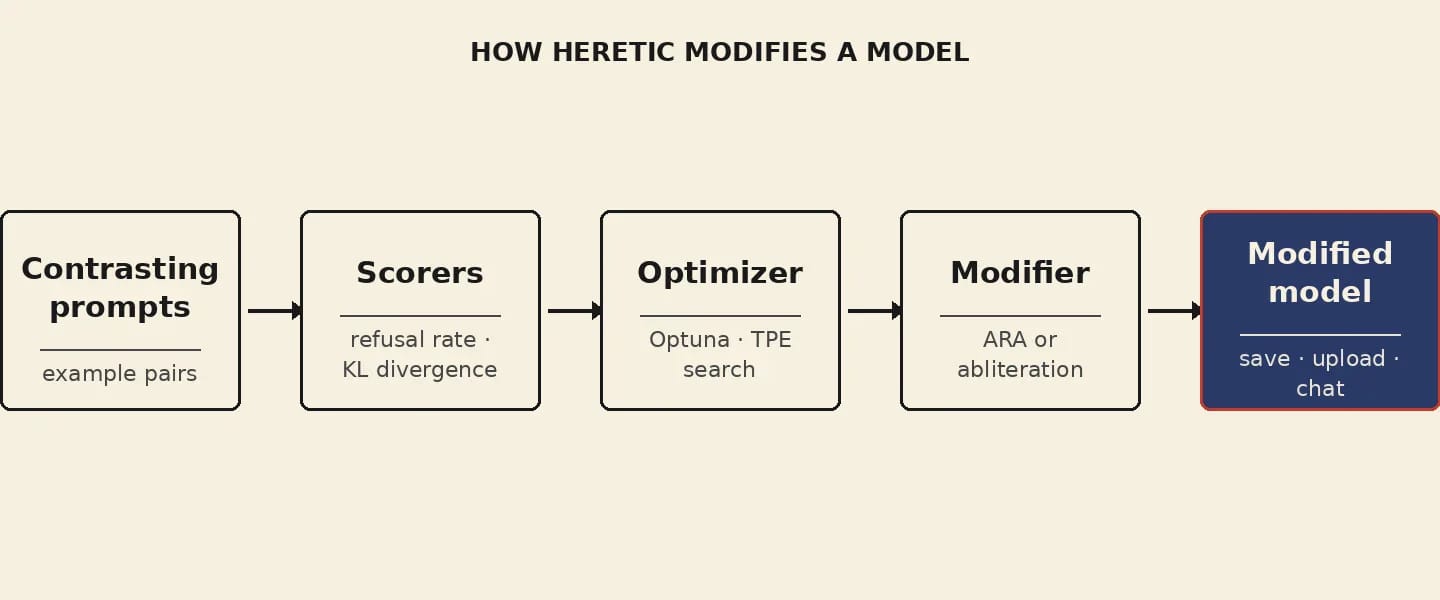
- Heretic steers models instead of training them: contrasting prompts, refusal-rate and KL-divergence scorers, an Optuna optimizer, and an ARA or abliteration modifier.
- The default configuration removes refusals; other configurations suppress slop, sycophancy, humor, or long answers. On an RTX 3090, a 4B model takes about 30 to 40 minutes.
- The Heretic Grimoire is a library of 9-kilobyte manifests that reproduce a processed model byte-for-byte, designed as a distributed, append-only backup.
- Nothing breaks today: the code, the heretic-llm 2.1.0 package, the community models, and the Grimoire remain, but no successor was named and the project's future depends on a fork.
"Dear friends of Heretic," the letter begins, "as foreshadowed a while ago, my journey has now come to an end."
Philipp Emanuel Weidmann posted those words on Friday morning as a GitHub issue titled "Farewell." By the time the post reached the top of Hacker News, the repository behind it was archived: read-only, with 43,604 stars, 5,600 forks, and seven releases behind it. He named no successor and suggested no particular infrastructure for what comes next. "The future of Heretic is now in the hands of all of you," he wrote.
Heretic was a small tool with an outsized idea. It let anyone with a gaming PC do something that usually takes a company with a training cluster: change how a language model behaves. The project's own description is blunt about the default setting. Run it on a model and it removes refusals, the behavior the community calls censorship removal. With a different configuration it suppresses slop, cuts sycophancy, shortens answers, or changes a model's emotional range.
Modify, don't train
Heretic does not train a model. It steers one. The tool feeds a model pairs of contrasting example prompts, scores the results, and searches for the small set of parameter changes that move the scores in the direction the user asked for. Two scorers run by default: one measures the refusal rate, the other measures KL divergence, a check that the modified model has not drifted too far from the original. An optimizer built on Optuna, a hyperparameter search library, runs the search. The changes themselves come from one of two modifiers: Arbitrary-Rank Ablation, a method developed for Heretic, or directional ablation, the technique the community calls abliteration, which finds the direction inside a model that corresponds to refusals and removes it.
The pitch was always about the hardware already in the room. Heretic needs Python 3.10 or newer and PyTorch 2.6 or newer, and the README's worked example is concrete: on an RTX 3090, processing Qwen3-4B-Instruct-2507 with the default configuration takes about 30 to 40 minutes. The tool supports most dense models, several mixture-of-experts architectures, multimodal models, and modern hybrid models, according to the README. The community has published thousands of models processed with Heretic on Hugging Face, the project says, and its README reports that those models have been independently benchmarked on standard tests like MMLU and GSM8K and compare favorably with models from competing abliteration tools.
Heretic modifies the models people run on their own machines, and the machine matters as much as the model. A 4B model fits almost anywhere, but whether it runs well depends on the memory and bandwidth of the hardware underneath it, as the VRAM math behind running models locally shows.
The Grimoire
Heretic's most unusual idea was not the modification itself. It was reproducibility. When a user uploads a processed model to Hugging Face, Heretic can include a small manifest, about 9 kilobytes, with everything needed to recreate the model byte-for-byte, provided the environment matches the original exactly. The manifest is machine-readable, and a single command reproduces the model in a few minutes without redoing the hours of computation. The project calls the growing library of these manifests the Heretic Grimoire, and it is designed as a distributed system: anyone can fetch a local copy of the public manifests and keep them as an append-only backup, even if the original model disappears from Hugging Face.
A farewell foreshadowed
The farewell was not a surprise to anyone following the project closely. In July, Weidmann posted an earlier announcement saying that at some point in the not-too-distant future, he expected to find himself permanently unable to develop software, and that he would have written his last line of code. He gave no reason in that post, and the farewell letter offers none either. Friday's letter says only that the day he described in July has arrived, and that it includes his work on Heretic, "which has meant so much to me."
The letter closes with the idea that motivated the project. "As AI continues to spread through your lives," he wrote, "you will find that controlling the models you use gradually transforms from an issue of Free Speech into an issue of Free Thought. AI will be the lens through which you see the world, not just a tool for getting things done. The fight for the ability to shape that lens yourself is nothing less than the fight for the humanity in you."
What still works
Nothing about Heretic breaks today. The repository is archived, which on GitHub means read-only: no new issues, no new pull requests, no new releases. But the code is still there under the AGPL-3.0 license, the pip package heretic-llm is still installable at version 2.1.0, the models the community made are still on Hugging Face, and the Grimoire manifests still reproduce them. There is also a Codeberg mirror, listed in the README. Weidmann encouraged interested contributors to organize on Discord or Matrix and decide for themselves whether and how to continue the project, deliberately naming no successor and suggesting no particular infrastructure.
Whether anyone does is the open question. A project with 43,604 stars and thousands of derived models does not vanish when its repository is archived, but it also does not maintain itself. The next Heretic, if there is one, will be a fork, and the community will have to choose one.