A 12-year-old flaw in Linux's NFS server hands root to anyone on port 2049
CVE-2026-99362 is a pre-authentication heap overflow in the Linux kernel's NFS server, present since 2014. One connection to port 2049 can end in a root shell, and the fix is out, but most distributions are still shipping it.

On this page
In brief
- CVE-2026-99362 is a pre-authentication heap overflow in the Linux kernel's NFS server: one TCP connection to port 2049 can lead to a root shell, with no login and no user interaction.
- Present since Linux 3.16 (2014): a client negotiates its reply cache down to zero bytes, then the server copies a full reply into it, 61 bytes past the end of the heap object.
- It was found twice, independently: by OpenSec's automated harness Antara, which built the full exploit on its own, and by ANSSI researcher Jérémy Jean, who wrote the upstream fix.
- Fixed kernels exist for eight branches, from 5.10.275 to 7.4-rc1, but Ubuntu still listed every supported release vulnerable on November 26, with fixes in progress.
- Until you can patch and reboot, firewall port 2049 to the storage network only, or turn off NFSv4.1 and 4.2.
One TCP connection. No username, no password, no click. A flaw in the Linux kernel's NFS server, present since 2014, lets anyone who can reach port 2049 corrupt kernel memory and end up with a root shell. It is called NFS2ROOT, it carries CVE-2026-99362 and a CVSS score of 9.8, and the fix has existed for weeks. That is not the same as the fix being installed.
The target is nfsd, the NFS server built into the Linux kernel, which parses network input before it knows who is on the other end. Anyone running it with NFSv4.1 or 4.2, the default, on a port reachable beyond the local machine is exposed: file servers, NAS appliances, build farms, Kubernetes storage nodes. This is not a client bug and not a misconfiguration. The server itself, doing what it was told, hands a stranger a write into kernel memory.
The reply cache, and the zero-byte buffer
NFSv4.1 sessions keep a cached copy of the last reply for each slot, so a request retried by the network is answered exactly once. The client negotiates how large that cache is. Negotiate it down to the minimum, and every slot gets a buffer of zero bytes.
That is the setup. The flaw is the order of the next two steps. When a client opens a session, the server runs SEQUENCE, the operation that starts the session, and narrows its reply buffer to the negotiated limit before accepting the slot. Pad the COMPOUND tag, the label on a bundled request, so the buffer fills right after the SEQUENCE opcode and before the status word that follows, and the encoder gives up without flagging an error. The server believes SEQUENCE succeeded, because nothing told it otherwise, and caches the whole reply, RPC and COMPOUND headers included, into a buffer with room for nothing.
The numbers come from the kernel's own memory-error detector, KASAN, in the upstream fix: 80 bytes copied, 61 of them past the end of the heap object, 40 of them chosen by the client, because the COMPOUND tag is copied along with the rest. A heap overflow is a write past the end of a block of memory the kernel set aside for one purpose, landing on whatever sits next to it. Here, what sits next to it is the bookkeeping for the neighbouring slot.
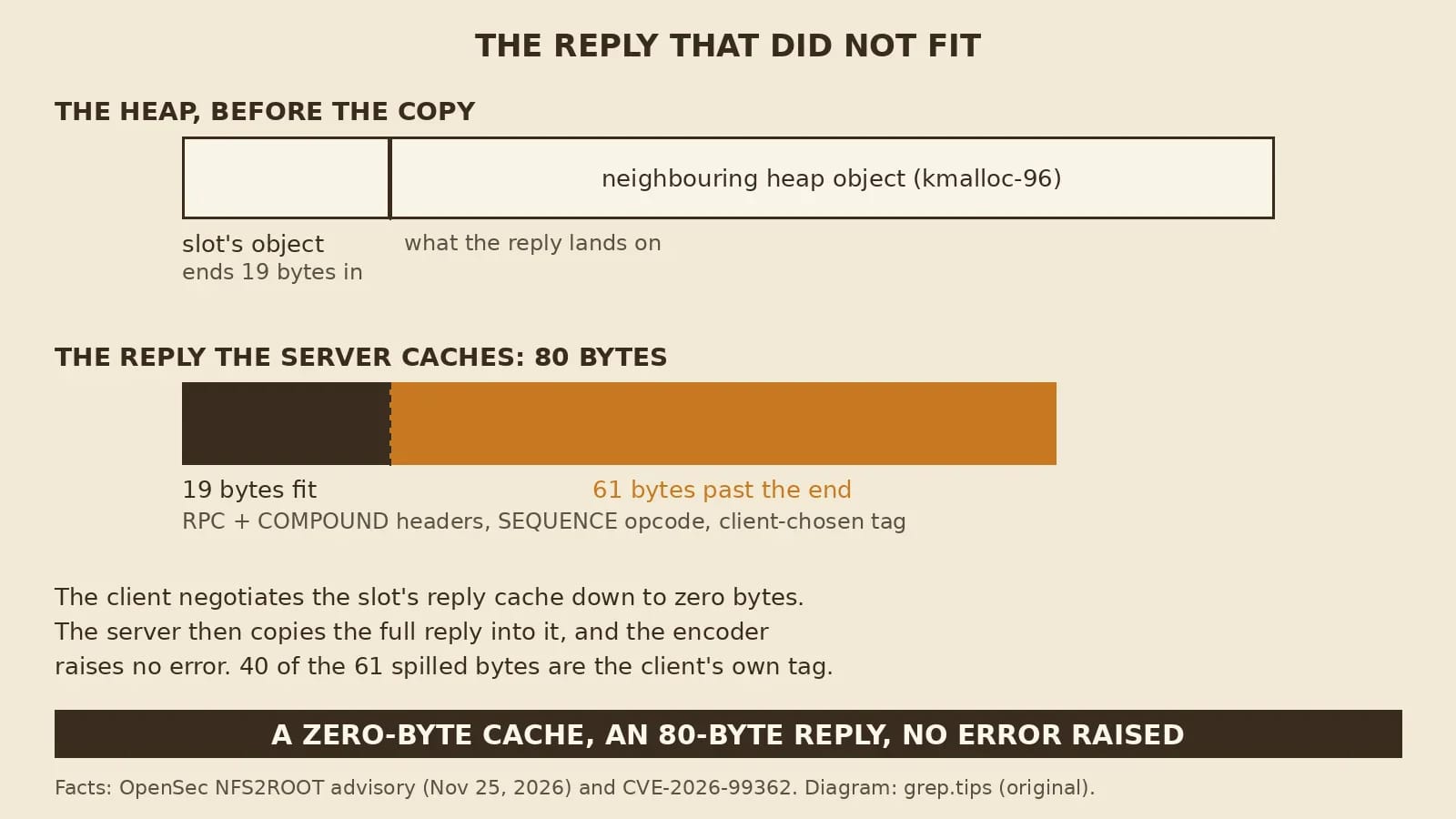
From there, the chain OpenSec demonstrated, in five steps, is ordinary NFS traffic: corrupt the neighbouring slot's bookkeeping, replay a request to leak 3.8 kilobytes of kernel heap and with it the KASLR slide, the randomization that hides where things live in memory, forge a pointer to free an object of the attacker's choosing, refill that memory with a fake callback built from NFS client names, and hang up. On disconnect, nfsd calls the fake callback, and the kernel runs a shell as root. In the recorded run the command was whoami; id; poweroff -f: the victim printed root, then uid=0(root), and switched itself off. OpenSec keeps the exploit itself private.
Twelve years in a few lines of C
The bug arrived in a commit from March 2014 that narrowed the reply buffer while handling SEQUENCE. It shipped in Linux 3.16, and every kernel since has carried it: long-term support, distribution, and appliance kernels alike. The flaw is not that the server trusts the client. NFS has always let the client negotiate the cache size, and a client asking for a small cache is not itself an attack. The flaw is that the server shrinks its own buffer before checking whether the reply fits, and the encoder's silent exit leaves no trace of the mistake. Each step looks reasonable on its own. Together they hand a remote stranger a write into kernel memory, and twelve years of releases, audits, and fuzzing walked past it.
The timeline, from OpenSec's writeup and the CVE record:
- March 2014: commit
47ee52986472narrows the reply buffer while handling SEQUENCE. It ships in Linux 3.16. - August 17, 2026: Jérémy Jean of ANSSI, the French cybersecurity agency, sends a fix upstream with a KASAN report.
- September 21, 2026: OpenSec's automated harness, Antara, flags the bug, scores it 9.8, and builds the full exploit.
- September 22, 2026: OpenSec reports the bug to the NFS maintainers and security@kernel.org, with the full exploit and a patch.
- November 19, 2026: CVE-2026-99362 is published.
- November 25, 2026: OpenSec publishes the NFS2ROOT writeup.
Found twice
The bug was found twice, from opposite directions. Jean found it by reading the code and wrote the upstream fix, in commits 5d5a72e965c8 and 241848cc774e, which preflights the SEQUENCE reply before accepting a slot. OpenSec says Antara, its white-box harness, flagged the reply-cache path, scored it, and built the leak, the arbitrary free, and the root shell with no human in the loop. That autonomy claim is OpenSec's own account, and the exploit is private, so it rests on their word and the recorded run. What is independently verifiable is the bug itself: the KASAN report in the fix, the CVE record, and the fact that two finders arrived at the same flaw within five weeks of each other. A flaw found twice in two months, by a machine and by a person, is a flaw that was waiting to be found.
Who is exposed, and what to do
Four conditions, all of them, mean exposed today: a kernel older than the fixed releases, with no distribution backport; nfsd loaded; NFSv4.1 or 4.2 enabled, which they are by default; and port 2049 listening on an address other than loopback. Four commands answer it:
uname -r
lsmod | grep -w nfsd
cat /proc/fs/nfsd/versions
ss -ltn 'sport = :2049'
The fixed releases exist for eight kernel branches: 5.10.275, 5.15.226, 6.1.193, 6.6.163, 6.12.117, 6.18.61, 7.3.2, and 7.4-rc1, released between November 6 and November 23. The packages are another matter. Ubuntu still listed every supported release vulnerable on November 26, with fixes in progress for 26.10 and 26.04 LTS and the rest still marked vulnerable. Red Hat calls the flaw Critical, scores it 9.4 on its own scale against the kernel team's 9.8, and notes that default Red Hat Enterprise Linux configurations do not run the NFS server, which limits exposure to systems deliberately set up to export shares. On a distribution kernel, the version number alone proves nothing, because vendors backport fixes under older numbers. Install the update that names CVE-2026-99362, then reboot.
Until the patch lands, close the port. Firewall 2049 so only the storage network can reach it, and check that the filter covers IPv6 too. Or turn off NFSv4.1 and 4.2 in /etc/nfs.conf, at the cost of pNFS and some 4.2 features, and restart the server. Red Hat's advice is the same in plainer terms: stop the NFS server if nothing needs it, or restrict the port to trusted networks. Kernel hardening does not remove the overflow, OpenSec warns. Patch every host.
The score deserves the usual caution. A 9.8 is a severity estimate, not a risk rating: it says how bad the flaw would be if exploited, under worst-case assumptions. The vector is what makes it urgent for an exposed host: network attack, low complexity, no privileges required, no user interaction. Nothing in the public record so far suggests the flaw has been exploited in the wild, and it had not been added to CISA's catalog of vulnerabilities known to be exploited as of November 25. That is the state of the record, not a promise. Our guide to reading a CVE without panicking lays out the triage order: the exploited list first, then presence, reachability, and consequence. This flaw answers the second question with a yes on any host serving NFS on a reachable port.
If exploitation comes, the signs to look for are in the advisory: kernel warnings from nfsd4_check_resp_size on every attempt, successful or not; kernel oopses with nfsd4_*, svc_*, or call_usermodehelper* frames; shells spawned by kernel workers on a file server; bursts of short NFSv4.1 sessions from a single source. The attack is valid NFS traffic, so there is no network signature to match. The warning in the kernel log is the signature.
The upstream fix landed weeks ago. The packages are still landing, and the gap between the two is where this flaw gets used, if it gets used. The check takes four commands, and the patch takes a reboot.