The AI patch flood just gave Linux networking a fifth maintainer
Linux's networking maintainers say they are completely overwhelmed by AI-generated bug reports and patches. The response: a fifth maintainer, deleted drivers, and AI reviewing AI.
On this page
In brief
- Willem de Bruijn is now the fifth Linux networking maintainer at large, promoted as the subsystem drowns in AI-generated patches.
- Maintainers say they are 'completely overwhelmed': a third to a half of recent networking patches look AI-driven and low priority.
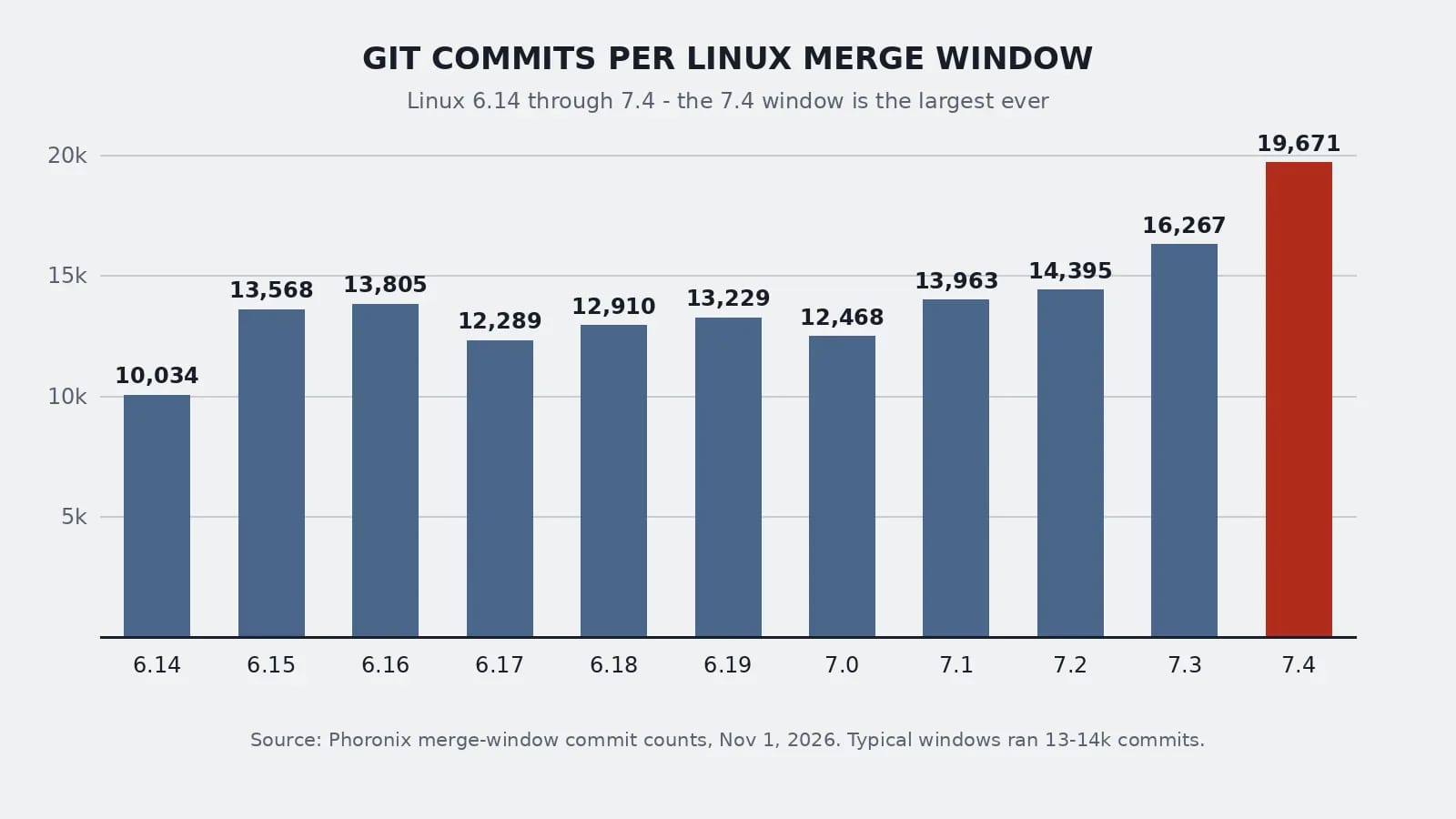
- The Linux 7.4 merge window took 19,671 commits, the largest ever; 7.3 was the first full cycle past 20,000.
- The response: more maintainers, deleting rarely used drivers, and using AI models to review AI-written patches.
- PostgreSQL 19 shipped on November 19, past its usual window, for the same reason: discovery scaled, review did not.
Linux's networking subsystem has a fifth maintainer. Willem de Bruijn, a Google engineer since 2011 who already maintains several of the stack's core protocols, was promoted this week to maintainer at large for all of networking, joining David Miller, Eric Dumazet, Jakub Kicinski, and Paolo Abeni. The change was merged as part of the networking pull request for Linux 7.4.
The promotion is the subsystem's answer to a workload problem its own maintainers have named in plain language: they are "completely overwhelmed" by AI-generated bug reports and patches, and the flood is not slowing down. The promotion adds review capacity where the queue is longest. It also says something about where the kernel's scarcest resource now sits. Finding bugs got cheap. Reviewing the fixes still costs a human afternoon, and there are only so many afternoons.
The scale of the flood
The numbers behind the promotion come from Kicinski's own accounting in the Linux 7.3 networking pull request. That cycle merged 632 patches to the stable networking tree and 648 to the development tree, and Kicinski estimated that a third to a half of the development-tree patches "seem like AI-driven low priority fixes, cleanups and clarifications." His summary of the situation was blunt: "We are completely overwhelmed, of course."
The surge runs across the whole kernel. The Linux 7.4 merge window took 19,671 commits, the largest merge window in the kernel's history. Merge windows usually ran 13,000 to 14,000 commits. Linux 7.3 was the first full kernel cycle to pass 20,000 commits, at 20,260. The source tree is approaching 42 million lines.
The flood is not spam. That is the part that makes it hard to dismiss. The bugs the models find are mostly real, in code that sat unexamined for years, and the fixes are often correct. What changed is the rate: anyone with a model subscription can point it at the tree and get a credible report, so the inbound rate jumped while the review capacity stayed flat. Maintainers have started diverting fixes to the next kernel version because the current one has no room left, and the networking team has removed rarely used drivers and old code in part to shrink the surface the agents keep finding things in.
More hands, less surface
The de Bruijn promotion is the direct response: a fifth maintainer at large for the subsystem carrying the heaviest load. Kicinski's nomination, in the patch that made it official, called de Bruijn "one of the pillars of the community" who "already maintains a bunch of core protocols and pieces of the stack," and asked to "make Willem a maintainer of all of networking."
The same week showed the other side of the ledger. Lorenzo Stoakes, a memory management expert at Arm who has contributed to the kernel since 2014, stepped away as a reviewer for the memory management, core, miscellaneous, and Rust areas on November 10. He will keep maintaining the areas he oversees, but he wrote that he lacks the bandwidth to offer general review "given the current throughput in the kernel resulting from AI-generated series," and that he wants to make his inbox manageable. One maintainer added, one reviewer stepping back: the review queue is the bottleneck, and it is being managed one person at a time.
Deleting old code is the quieter lever. The networking maintainers have been dropping drivers and subsystems that are likely unused by anyone running a modern kernel, explicitly to reduce the AI patch noise around them. Less code means fewer places for an agent to find a plausible-looking defect, and fewer patches for a human to read.
Fight AI with AI
The third response is to hand more of the work to the models themselves. Kicinski wrote in the 7.3 pull request that the team secured enough model budget and access, thanking Meta, to run reviews with multiple frontier models on every patch, which he said eliminates some hallucinations. The direction he sketched for the next release is to let the models take over the busy work: managing the patch queue, automating common process complaints, editing commit messages, and possibly applying patches that already carry review tags from people the maintainers trust.
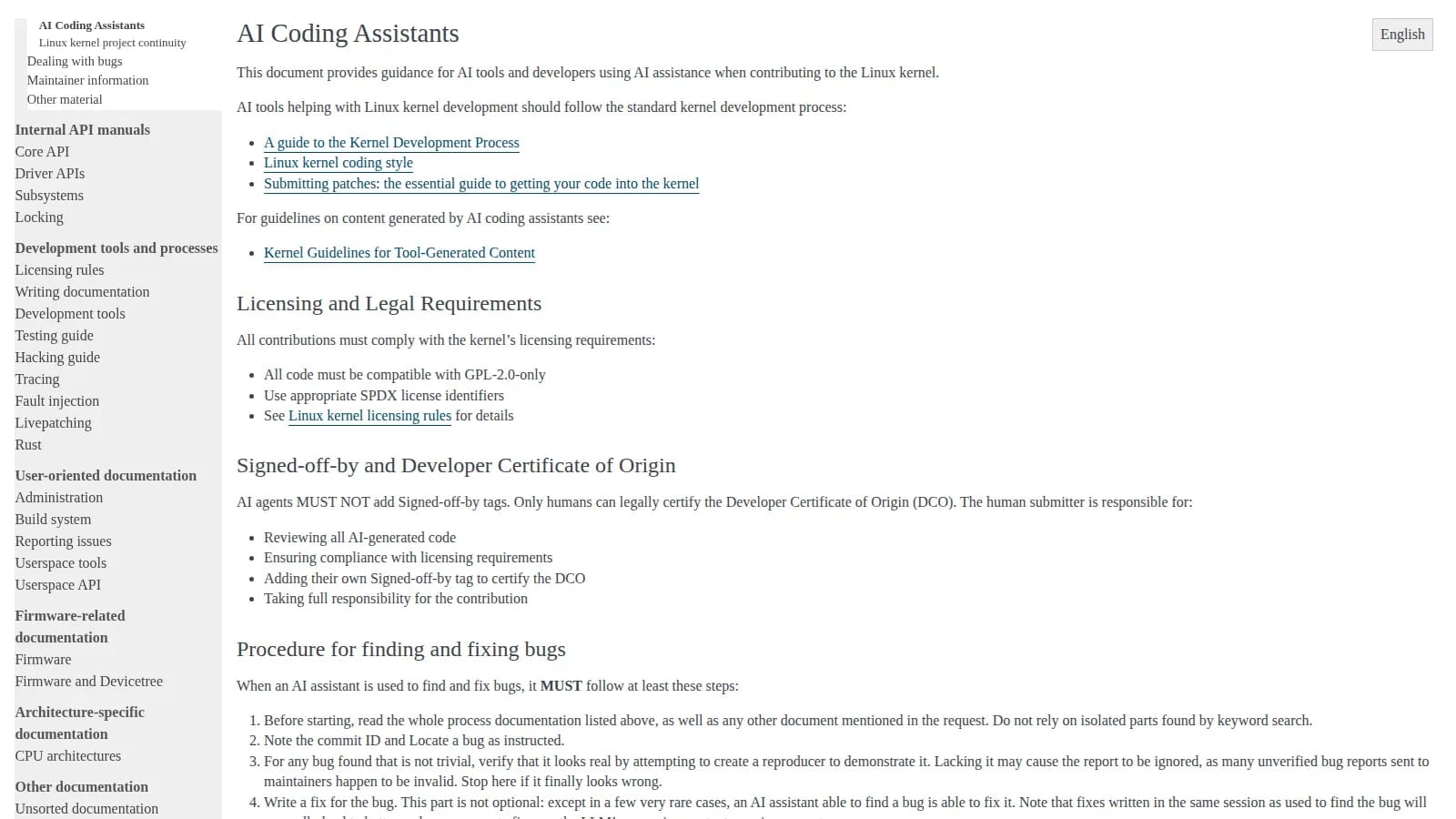
The kernel is also writing down how agents should behave. Sasha Levin, an NVIDIA engineer who co-maintains the long-term stable kernels, has been building a set of AI agent skills for the tree, and Phoronix reports he intends to submit them for the Linux 7.5 merge window in late December. The skills live in a new agents/skills directory and cover the mechanical parts of contributing: choosing the right Fixes tag, choosing stable tags, finding other instances of a fixed bug, writing commit messages, and writing KUnit tests. The kernel's written policy already sets the boundary: AI agents must not add Signed-off-by tags, only a human can certify the Developer Certificate of Origin, and the human submitter reviews the code and takes full responsibility for it.
The same problem, one project over
PostgreSQL reached the same conclusion a month earlier, with numbers. Robert Haas, a committer on the project since 2009, wrote in October that PostgreSQL 19 would slip to November because "LLMs happened." Between the April feature freeze and September 25, commits back-patched to the release in progress rose from 724 in 2025 to 1,169 in 2026, a jump of more than 60 percent. Backports to the previous release rose from 248 to 433, more than 74 percent. Three large features were pulled late in the beta period, between August 27 and September 15, because the time that would have gone into deciding what belonged in the release went into fixing bugs in older branches instead.
PostgreSQL 19 shipped on November 19, past the project's usual mid-September to mid-October window. Haas's short version of why: finding bugs got vastly easier, fixing them got easier but not to the same degree, and "those humans have not gotten any smarter between 2025 and 2026." His longer worry is the one the kernel is now living with: given forty years of bugs that humans were unable to find but models are quite capable of discovering, how does a project ever catch up, and how does it keep innovating at the same time.
The rulebook already exists
The kernel's most public argument about the flood happened two days before the de Bruijn promotion. Torvalds merged a 41,204-line EXT4 pull request for Linux 7.4-rc5, then told its author to get his AI companion in order. The pull, from EXT4 maintainer Theodore Ts'o, carried mostly AI-generated fixes and new KUnit tests built to make AI-generated patches safer to check. Torvalds took it, with serious reservations, and then wrote back that a fix for a subtle bug is itself likely to be buggy, and that release candidates exist to calm a release down, not to absorb tens of thousands of lines of new work.
The policy behind his objection has been written down since Linux 7.0, in the kernel's own AI Coding Assistants document: an agent must read the whole process documentation, verify a bug with a reproducer before reporting it, write the fix, build and check it, and leave the result for a human to review. The agent never sends anything itself, and never signs for it. Linux 7.4-rc5 is due Sunday, November 29, and the release-candidate weeks are now the test of both sides of the argument: the fixes in that pull either hold, or one of them breaks something and the warning becomes the story.
The de Bruijn promotion, the Stoakes step-back, the deleted drivers, the model-run reviews, and the agent skills are all the same answer from different angles: the kernel cannot review its way out of this flood with the people it has, so it is adding people, shrinking the surface, and automating the parts of review that do not need a human. The next test is the Linux 7.5 merge window in late December, when the agent skills are due to land. The open question is the one Haas asked in October, and it has no answer yet: when finding a bug costs almost nothing and reviewing the fix still costs an afternoon, how does a volunteer project ever catch up.