OpenAI's Private Inference, explained: what it seals, and what it doesn't
OpenAI is testing Private Inference, which keeps business prompts encrypted while its models work on them. The protection is real but narrow, and OpenAI's own white paper says so.
On this page
In brief
- OpenAI is testing Private Inference with a small group of business customers, CEO Sam Altman announced November 25.
- It runs model work inside confidential-computing hardware so prompts and responses stay protected while the model processes them.
- It is the second half of Private Intelligence: Zero Data Retention covers what happens afterwards; Private Inference covers the processing moment.
- OpenAI's white paper is narrower than the headlines: no inference-wide zero-operator-access guarantee in the standard runtime, and Private Inference does not automatically cover the initial request.
- No models, pricing, or general-availability date have been published; interested businesses are directed to contact OpenAI's Shekar on X.
Your prompt to an AI model is encrypted on the way in, and under Zero Data Retention it is not kept after the answer. In between, while the model is working on it, it is readable. That middle moment is the one OpenAI has never been able to promise anything technical about, and it is the one its new Private Inference feature is meant to close.
On November 25, chief executive Sam Altman said on X that OpenAI is testing Private Inference with a small group of business customers. The feature runs model work inside confidential computing hardware, so prompts and responses stay protected while the model processes them. It is the second half of Private Intelligence, the privacy package OpenAI announced at its DevDay conference on September 29. The first half, Zero Data Retention with Private Safety Processing, is already rolling out to API customers. Private Inference was listed then as a preview coming in the fall. Two months later, it has its first test customers.
Before, during, and after
Private Inference is not a promise about what OpenAI keeps. It is a promise about what OpenAI can see while the model runs. The distinction matters because OpenAI's privacy protections each cover a different moment in a prompt's life, and until now the middle one had no technical protection at all.
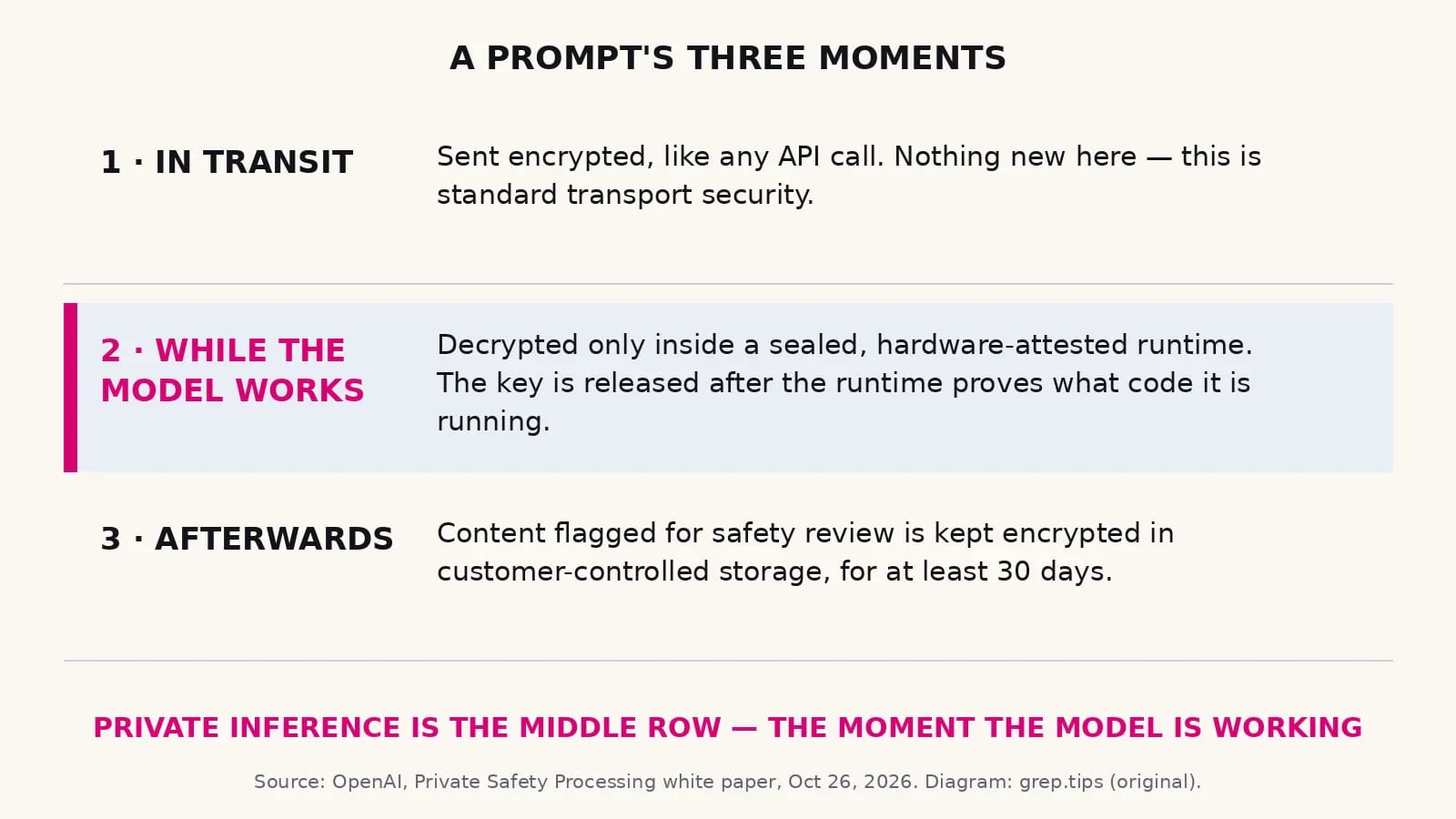
The first moment is transit. Your prompt travels encrypted, like any API call. The third moment is afterwards. Under Zero Data Retention, available for eligible API workflows, OpenAI does not retain prompts or responses after processing, and enterprise customer data is not used to train models unless the customer opts in. The middle moment is processing, when the model needs the plaintext to do its work. That is the gap Private Inference is built to close.
Private Safety Processing, the part already rolling out, sits between the second and third moments. When a safety classifier flags an interaction, or an approved sampling policy selects one, the content is encrypted and stored in storage the customer controls, where the customer keeps it for at least 30 days. OpenAI keeps only operational metadata and a storage reference, not a plaintext or encrypted copy. The retained content is decrypted later, inside OpenAI infrastructure, only for approved automated safety review. OpenAI says it can sample up to 100 percent of traffic for that review, depending on the product. A safety referral does not establish a policy violation.
How the seal is supposed to work
Confidential computing is the mechanism. The work runs inside a hardware-isolated environment, a trusted execution environment, where memory is encrypted and isolated from other workloads and debugging features are disabled. The environment has to prove itself before it gets anything to work with.
OpenAI's 38-page technical white paper on Private Safety Processing, published October 26, describes the chain for its safety reviews, and the same architecture is the model for Private Inference. The decryption key is released only after the runtime's identity, hardware attestation, and software measurements are checked against a release policy. No human access group can release the key. The measurements go into a tamper-evident transparency log. The inner encryption keys rotate daily and are destroyed after 30 days. Only bounded safety decisions and operational metadata leave the runtime in plaintext for OpenAI personnel to see.
The point of the design is that the guarantee does not rest on policy. It rests on the key only going to a measured workload, and on that workload being able to say very little. That is a stronger claim than "our employees are not allowed to look," and it is also a narrower one, which is where the paper gets interesting.
What the paper says it does not do
Read the white paper's own boundary section and the announcement gets smaller, in a useful way. "The standard Private Safety Processing runtime is protected from human access, but its storage-disabled inference path does not provide an inference-wide Zero Operator Access guarantee. Private Inference is an optional protection that extends operator access protections and attestation to eligible safety-inference workloads. It does not automatically cover the initial API request, which keeps its configured data retention protections, or every OpenAI system."
Three limits follow from that paragraph. First, the base safety-review product does not carry a no-operator-access guarantee across the inference path; Private Inference is the optional extension that adds it, for eligible workloads. Second, the initial API request is not automatically covered; it keeps whatever retention protections it already had. Third, the paper covers OpenAI's own first-party traffic only. Amazon Bedrock and other third-party distribution are outside its scope.
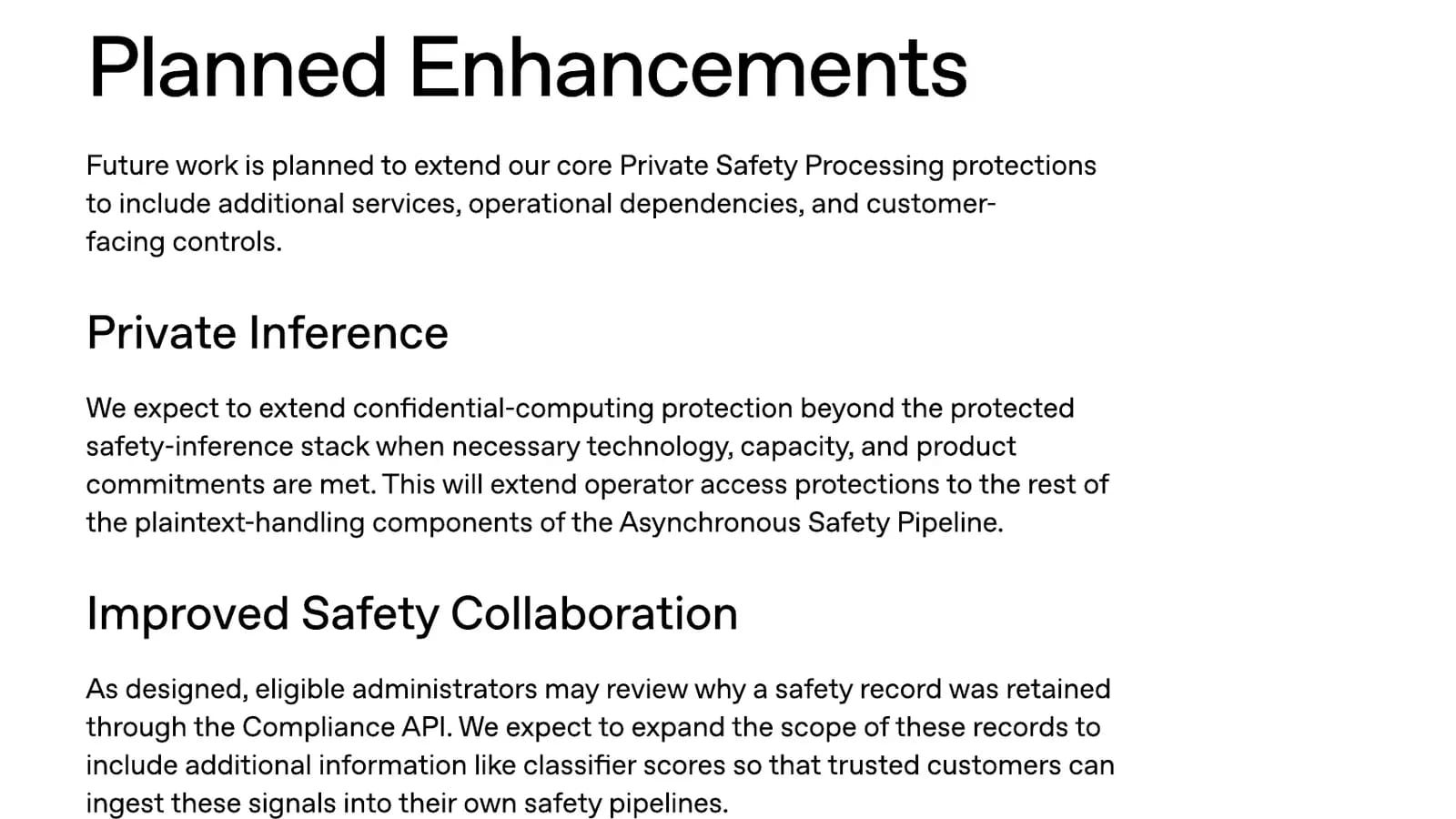
The paper is candid about other edges, too. Images flagged for potential child sexual abuse material are still retained for manual review and reporting, even in Zero Data Retention deployments, because OpenAI is required by law to report them. And the planned-enhancements section describes Private Inference as future work, to be extended "when necessary technology, capacity, and product commitments are met." The alpha test is the first step past that sentence, not the finished product.
The other lab is building the same thing
OpenAI is not alone in this direction. Anthropic published its own confidential-inference research in June 2025, updated in October, describing a design in which requests stay encrypted until they reach a small trusted loader running in an isolated virtual machine, and model weights are decrypted only at that loader and never released from it. Anthropic's post is explicit that the work is early: "it is too soon to forecast how it will evolve into specific designs or features we might offer in the future."
In October, the confidential-AI company Opaque Systems announced that its team is joining Anthropic. Anthropic told The Information it is licensing Opaque's technology and hiring some of its engineers, according to coverage of the move; Opaque's chief executive Aaron Fulkerson and chief technology officer Rishabh Poddar are joining. As of November, Anthropic has not published its own statement about the arrangement. The shape of the race is clear enough: OpenAI has an alpha in customer testing, Anthropic has the research and the team, and neither has a product a customer can buy yet.
What to ask before relying on it
Private Inference is an alpha pilot for business API customers, not a privacy upgrade for ChatGPT. OpenAI has not published which models it supports, what it will cost, or when it opens more widely. Altman directed interested businesses to contact Shekar, the OpenAI employee leading the effort, on X. Shekar said there that OpenAI is getting the confidential-compute capacity to scale the pilot up. There is no signup page and no published performance overhead for running inside confidential hardware.
The questions that decide whether it is useful are the ones the announcement leaves open. Does the alpha cover the initial API request, or only the safety-inference workloads the white paper describes? What can a customer verify independently about the runtime, and what attestation evidence do they get? Which models and regions are included, and what does the sealed environment do to latency and cost? Until that documentation exists, the sensible move for a business weighing Private Inference is the one the white paper invites: ask which workloads are eligible, what the attestation covers, and whether the initial request is inside the seal. The alpha is invite-only and the documentation is unpublished, so the paper is the most precise statement available. Read its boundary section first. That is where OpenAI says, in its own words, what the seal does and does not cover.