FBI: an AI hacking agent can break into a network in under three hours
The FBI's FLASH-20261113-001 warns that ARTEX, an open-source AI penetration-testing framework, is being weaponized to automate intrusions from recon to data theft — some in under three hours.

On this page
In brief
- The FBI's FLASH-20261113-001 warns ARTEX automates intrusions from recon to data theft, some reaching privileged access in under three hours.
- ARTEX is an open-source, multi-agent framework written in Go that turns plain-language goals into commands, plugging into Claude, GPT, DeepSeek, GLM, Grok, and Kimi.
- Two campaigns stand out: personal data on about 67,000 people taken from South Korean financial firms, and a ConnectWise supply-chain compromise reaching 2,250+ downstream tenants.
- The developer pulled the GitHub repo on October 8, 2026, but forks, archived copies, and ARTEX PRO keep it circulating; researchers found 1,600+ exposed consoles.
- The FBI's advice is unglamorous: inventory every internet-facing app, lock down admin paths, and watch for unexpected calls to LLM APIs.
The FBI has a name for the thing that has been breaking into networks faster than security teams can respond to it, and the name comes with a warning: the break-ins are now measured in hours, not weeks.
On November 13, the bureau published FLASH-20261113-001, a threat overview of ARTEX, an open-source penetration-testing framework that threat actors have turned into an automated intrusion machine. Since at least August 2026, the FBI says, "a variety of malicious cyber actors" have used it against organisations in ten sectors, from financial services and government to energy and healthcare. In some intrusions, the time from first targeting to privileged access was under three hours.
What ARTEX is
ARTEX started life as a legitimate tool. It is an autonomous, multi-agent penetration-testing platform written in Go, released on GitHub in July 2026 by a developer using the name "Autumn-27", who said it was meant for authorised security testing. You give it a goal in plain language, and its specialised agents translate that goal into commands, run them, and adapt to what they find, with minimal human input after the objective is set. The framework ships with no AI model of its own; it plugs into outside providers — Claude and GPT at the frontier end, DeepSeek, GLM, Grok, and Kimi at the open and Chinese-origin end. In attacker-run installations, the FBI says, Chinese models are most common, with DeepSeek's Flash family dominating on capability, low cost, and a lack of observable guardrails when framed as penetration testing.
Within ten weeks of release, ARTEX had gathered an estimated 1,500 to 2,000 GitHub stars. Then the abuse reports arrived, and on October 8 the developer took the repository down. It did not matter: forks, archived copies, localised versions, and a paid edition called ARTEX PRO keep it in circulation, and researchers had found more than 1,600 publicly exposed ARTEX consoles by early November. The FBI says the real number is likely significantly higher once systems behind firewalls are counted.
How the break-ins work
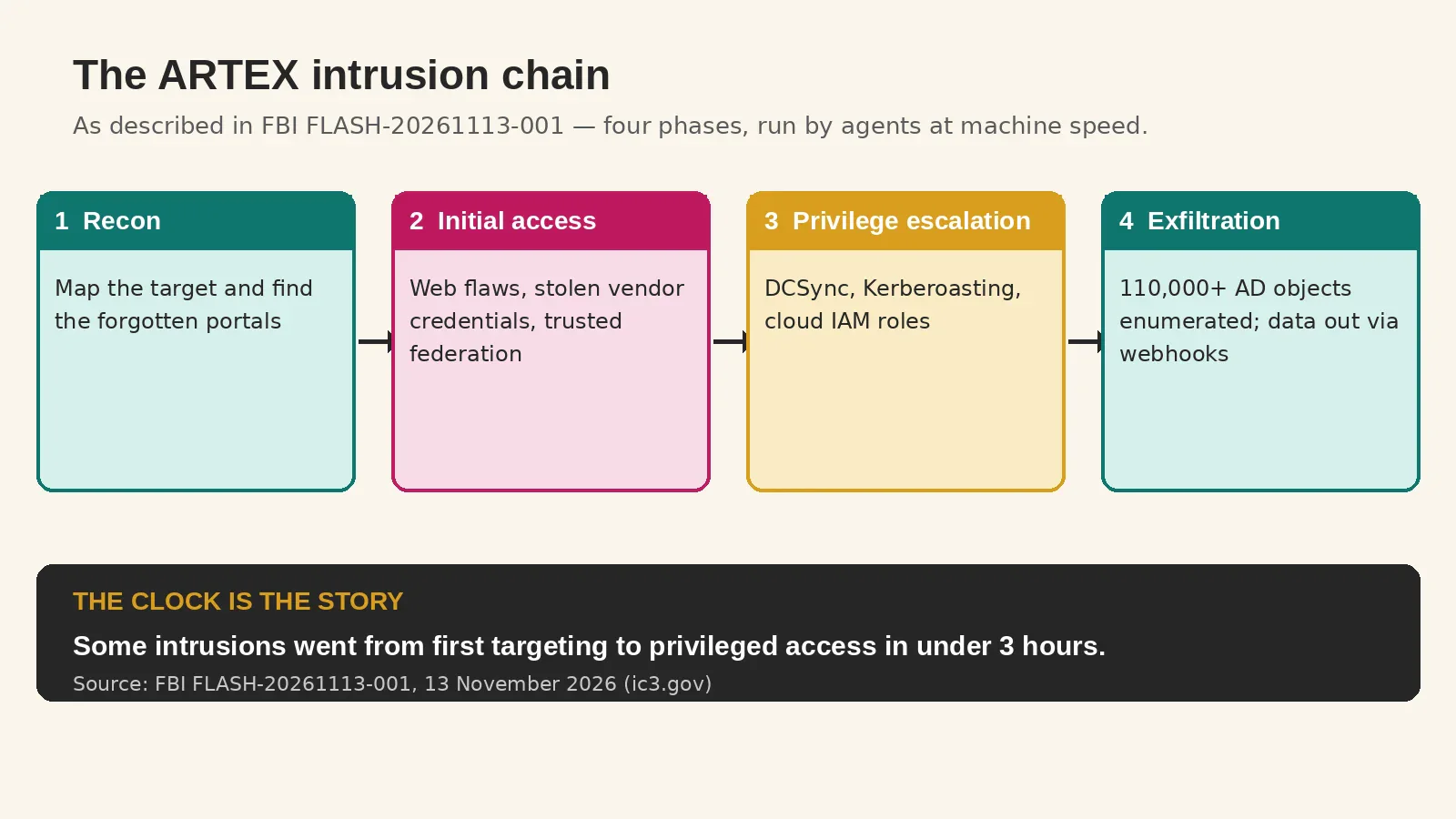
The alert's table of observed tactics reads like a tour of the places security teams forget to look. ARTEX is good, the FBI says, at finding and exploiting peripheral systems: partner and supplier portals, mobile back-ends, employee applications, sales-support systems, legacy services, and third-party integrations.
Initial access came through a familiar catalogue of web flaws — unsigned SAML assertions, XML external entity injection, server-side request forgery, template and SQL injection, command injection, anonymous file uploads, hardcoded administrator passwords sitting in JavaScript bundles, and APIs with no authentication at all. The agents also pivoted through compromised vendor credentials and trusted business-to-business federation, using one organisation's trust in another as the way in.
Once inside, the agents left a trail of persistence: JSP and PHP web shells, abuse of Kudu administrative APIs to run arbitrary commands, open-source remote-access tools such as WISP, vshell, and AdaptixC2, new SSH key pairs, and credentials quietly added to existing OAuth applications so the access would survive a password reset. For privilege escalation, they launched cloud instances with high-value IAM roles, harvested service tickets with Kerberoasting, and ran DCSync to steal the domain's krbtgt key — in a Windows domain, effectively the master key to everything.
The internal reconnaissance numbers show what machine speed really buys. In one environment, agents enumerated more than 110,000 Active Directory objects, read LAPS passwords, and inventoried endpoint coverage to find the Windows machines without CrowdStrike Falcon installed — then aimed the lateral movement at exactly those machines.
The two campaigns that stood out
The FBI names two campaigns. The first was financially motivated attacks on South Korean financial institutions, which led to the theft of personal information on approximately 67,000 people. The second was a supply-chain compromise affecting ConnectWise Cloud Backup customers, which gave attackers access to more than 2,250 downstream tenants.
The attribution question is worth being precise about. The FBI's own text does not name a country behind ARTEX activity. Its footnotes, however, cite a Microsoft Threat Intelligence report from October 21, 2026, headlined "AI-driven, large-scale nation-state campaign using ARTEX enables supply chain compromise." Microsoft attributes the ConnectWise campaign to Storm-0940, an actor it describes as China-state aligned, active since 2021, and says the group used ARTEX against hundreds of organisations globally since as early as September 2026. Microsoft also reports a password-spray campaign from October 10 to 14 that produced more than 151,000 failed logons against 327 accounts at eight organisations, peaking at about 2,900 attempts per minute — none of which succeeded, but which shows the scale the automation makes possible.
The repository is gone. The tool is not.
There is a pattern here that security teams have seen before. A dual-use tool is published for defenders, adopted by attackers, and pulled by its author — and the pull changes almost nothing, because the code is already copied, forked, and sold. ARTEX's author removed the GitHub repository on October 8, 2026. A month later, the FBI was counting more than 1,600 exposed consoles and warning that the real deployment count is likely far higher. The point is not that penetration-testing frameworks should not exist; it is that a framework which turns a plain-language goal into a full intrusion chain, running on cheap models with no guardrails, lowers the floor for who can run a serious attack. The FBI puts it plainly: ARTEX "enables threat actors with minimal technical expertise to conduct complex, multi-target operations simultaneously."
What the FBI is asking defenders to do
The alert's recommendations are unglamorous, and that is the point. Start by inventorying every internet-facing application — explicitly including the peripheral ones: partner and supplier portals, mobile back-ends, employee apps, legacy services, and third-party integrations. Restrict cloud administration, Kudu and SCM endpoints, hypervisors, and backup platforms to trusted networks. Apply least privilege to multi-tenant application permissions and consent grants, and watch for new credentials being added to applications. Put rate limits and alerts on partner and employee portals to catch rapid, sequential lookups. Scan code, configuration, and CI/CD pipelines for embedded secrets and rotate anything exposed.
For Microsoft cloud shops, the alert adds specifics: review every Microsoft 365 tenant where affected ConnectWise applications are or were installed, search by application ID rather than display name, and review activity starting from at least October 1, 2026. Preserve the evidence — Entra sign-in and audit records, Purview records, SIEM data — without delaying urgent containment.
None of this is new advice. That is, in a way, the story: know what is exposed, lock down the admin paths, watch the identities, and assume the forgotten portal is the one that gets hit. What changed is the clock. When an attacker can go from first probe to domain administrator in under three hours, the gap between "we should inventory that" and "we did inventory that" is the whole ballgame. The alert is marked TLP:CLEAR, and the FBI asks anyone who suspects they were targeted to report through their local field office or ic3.gov — including, notably, any unexpected outbound calls to LLM API endpoints. That is the new tell: a compromised network does not just phone home to a command server any more. It phones an AI provider.