A thousand servers, one playbook: Japan maps the AI attack fleet
A Japan-led probe found about 1,000 servers suspected of running AI attack tools since October. The count is suspected infrastructure, not confirmed breaches — and that distinction is the story.

On this page
In brief
- A Japan-led probe found about 1,000 servers suspected of supporting AI-driven cyberattacks, online since October; JPCERT/CC is still tracking 600 to 700 of them.
- Most hosted AI penetration-testing platforms such as ARTEX — and JPCERT/CC also named Cairn and CyberStrikeAI, which ran 44 agents across a full kill chain.
- The servers were used to scan for known vulnerabilities and attack via APIs — including pulling apart published apps to find the servers behind them.
- 1,000 servers is suspected infrastructure, not confirmed breaches; no count of successful break-ins through these servers has been established.
- Japan answered with a ¥10 billion emergency cybersecurity package on November 6, after 600+ incidents were publicly reported in the first nine months of 2026.
A thousand servers is not a hack. It is a factory floor. That is the number a Japan-led international investigation put on the suspected infrastructure behind the autumn's AI-assisted cyberattacks: about 1,000 servers, online since October, most of them running AI-powered penetration-testing platforms. The probe, described by Kyodo News on November 14 and 15, is the clearest picture yet of what the AI attack economy looks like from the outside — not one clever tool, but a fleet of them, pointed at websites around the world.
The investigation was run by the Japan Computer Emergency Response Team Coordination Center, JPCERT/CC, working with overseas cybersecurity firms. It began in early October, and the centre was still tracking 600 to 700 of the roughly 1,000 servers it had identified. The servers, the investigators said, appeared to be searching for weaknesses in websites and trying to steal configuration files — documents that often contain the keys to everything else.
What the probe found
The important word in the finding is "suspected". A thousand servers is a count of infrastructure that looks like attack infrastructure, not a count of successful break-ins. Nothing in the reporting establishes how many organisations, if any, were actually breached through these particular servers. The real story is scale, not a single spectacular incident.
Most of the servers hosted AI-powered platforms such as ARTEX, the open-source penetration-testing framework the FBI warned about on November 13. They also carried tools for testing system vulnerabilities and analysing the internal structure of smartphone apps, used to attempt unauthorised access through APIs.
One server contained traces of a programming support tool built by Anthropic — a data point, not a conclusion: the investigators did not say it powered the suspected activity, and one trace out of a thousand servers says nothing about who was behind the operation. JPCERT/CC analyst Ken Sajo warned that AI use in cyberattacks is still at an early stage and that "more sophisticated attacks will increase in the future."
Not one tool, a shelf of them
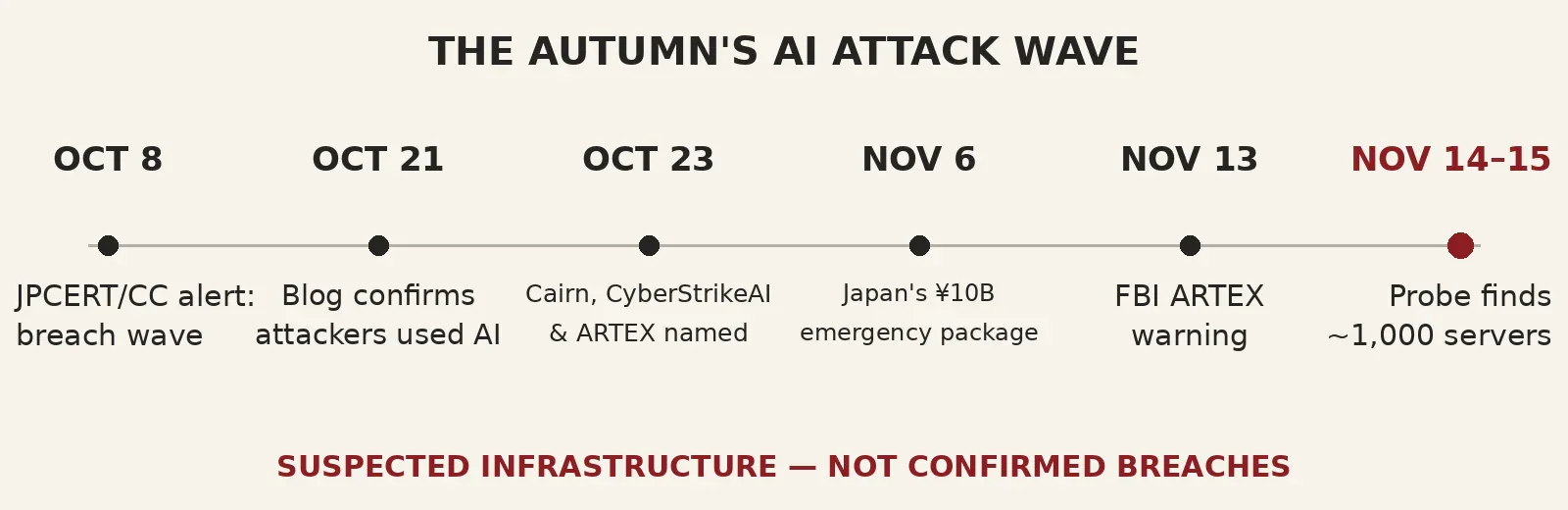
ARTEX is the name that made headlines, but the investigations behind the probe keep turning up more names. On October 23, JPCERT/CC updated its advisory on the breach wave to name three AI penetration-testing platforms seen in attempted attacks: Cairn, CyberStrikeAI, and ARTEX. A TrendAI analysis published October 27, built from three attacker servers left open to the internet, found three separate operations using AI at different levels — and said they were separate from the previously reported ARTEX activity.
The most striking ran CyberStrikeAI, an open-source platform written in Go, as a full kill chain: reconnaissance, exploitation, command and control, persistence, exfiltration, and reporting. A log entry, "credential-search agent 8/44", showed the work split across 44 agents. In a short October burst it probed at least 19 organisations, 16 of them in Japan, throttling traffic so no single victim saw much of it. Even so, TrendAI's scorecard is humbling: for many targets the platform logged no session, no web shell, and no exfiltration, and the deepest compromise began at an unauthenticated admin page on an old web system.
The other two operations were less automated. One was human-led, with a language model drafting attack plans after the operator claimed to be running an authorised assessment; it scanned more than 6,000 Japanese IP addresses but hit only one or two firms hard. The third used AI mainly for tooling, probing edge devices from Cisco, Citrix, F5, and Yamaha, plus more than 1,300 candidate Oracle WebLogic servers. All three worked in Simplified Chinese, which the researchers call a weak clue; they made no attribution.
The pattern matches what the FBI described in its ARTEX alert the same week: the framework has been weaponised since at least August 2026, with some intrusions going from first targeting to privileged access in under three hours, personal data on about 67,000 people taken from South Korean financial institutions, and a ConnectWise supply-chain compromise reaching more than 2,250 downstream tenants. The developer pulled ARTEX from GitHub on October 8; researchers had already found more than 1,600 exposed ARTEX consoles by early November.
What the servers actually did
JPCERT/CC's technical write-up, published October 21 after examining the attackers' servers, shows the work in detail. The attackers analysed Android application packages — APK files — to find the APIs behind a company's services, then attacked those APIs directly. On one server they found APK files plus Blutter and jadx, tools for reverse-engineering Flutter and Android apps, and a Python script returning redirect responses, apparently to test for server-side request forgery.
The centre's conclusion was precise: the attackers had used AI "to scan for known vulnerabilities and carry out attacks via APIs." Known vulnerabilities. Nothing in the investigation points to AI discovering new, unknown flaws. The attacks worked because the flaws were already there — secrets embedded in apps, APIs with no server-side authorisation, URL-fetching features that follow redirects without checking where they land. Japan's NICT institute calls one pattern the A2B, or app-to-backend, attack: a published app pulled apart to find and abuse the servers behind it.
The number that matters, and the one that doesn't
It is tempting to read "1,000 servers" as "1,000 attacks". It isn't. It is a measure of capacity: machines standing by, running tools that never sleep and never get bored. The number that matters is the one the defenders control — how many of the weaknesses those tools look for are still sitting exposed.
Japan's own figures show why the country is taking the capacity seriously. More than 600 cybersecurity incidents were publicly reported in the first nine months of 2026, according to TrendAI data cited by Dark Reading, already surpassing the 594 reported in all of 2025. On November 6, Prime Minister Sanae Takaichi announced an emergency cybersecurity package backed by about ¥10 billion — roughly $63 million — in initial funding, built on four pillars: basic measures nationwide including AI for cyber-defence, stronger investigation capability, faster strategic response, and better support for victims.
What defenders should take from it
JPCERT/CC's advice, published with its October findings, is the least glamorous part of the story and the most useful. Do not embed private keys or long-lived credentials in apps. Do not rely on request signing or code obfuscation in the app; authenticate and authorise on the server. Rate-limit APIs and watch for abnormal requests, assuming the caller may be something other than your own app. For APIs that fetch external URLs, restrict the destinations and validate them again after redirects.
None of that is new. What is new is the arithmetic. When the other side can stand up a thousand servers, each running dozens of agents that check every forgotten admin panel, every default credential, and every configuration file left in the open, the gap between "we should fix that" and "we fixed that" is measured in break-ins, not in quarters. The probe found a fleet, and it is still out there — 600 to 700 of its servers still being watched, the rest presumably replaced or moved. The tools are open source, the techniques documented, and the next fleet will be cheaper to build than this one.