Gemini 4 Hydrogen: the fast model that outscored Google's Argon
Google's new Gemini 4 Hydrogen is 2.5 times faster than the model it replaces, beats the frontier Argon on the headline intelligence index, and is now the default model in Search. The fast tier is no longer the compromise tier.

On this page
In brief
- Hydrogen finishes tasks 2.5 times faster than Gemini 3.8 Flash at its default high thinking setting.
- It scores 51 on the Artificial Analysis Intelligence Index at default settings, against 50 for the frontier Argon, and 54 at its highest xhigh setting.
- Pricing is flat at $1.50 per million input tokens and $7.50 per million output tokens across a 1-million-token window.
- Four thinking levels — low, medium, high, xhigh — let you pay only for the reasoning depth a task needs.
- Hydrogen is now the default model in Google Search's AI Mode and is rolling out across AI Studio, the Gemini API, the Gemini app, and Antigravity.
The fast model outscored Argon
On November 12, Google introduced Gemini 4 Hydrogen, the newest member of its Gemini 4 family — and the one that scrambles the family's logic. Until now the lineup was easy to read: Carbon and Argon, the frontier models, did the deep, long-horizon reasoning on your hardest problems, while the fast model handled the everyday work. Hydrogen is the fast model. It also beats Argon on the Artificial Analysis Intelligence Index at its default setting, 51 to 50, and reaches 54 at its highest thinking level. The model built for speed beat Argon, one of Google's two frontier models, on the industry's broadest public benchmark — but not Carbon, which Google calls its strongest model.
That is the story here, more than the launch itself. Google did not just ship a faster Flash. It retired the Flash name, made the fast model the default across its surfaces, and put a reasoning dial on it — four thinking levels, from low to a new extra-high tier, so you pay in time and tokens only for the depth a task actually needs.
What Hydrogen actually is
Hydrogen is the execution engine of the Gemini 4 family. Carbon and Argon keep the deep-reasoning jobs: architecture, untangling subtle bugs, the problems that take hours of thought. Hydrogen does the rapid work: writing code, running tests, verifying changes, and the multi-step agentic jobs — deep research, data analysis, navigating a large codebase — where speed matters more than the last point of reasoning quality.
It is available everywhere Google sells Gemini, all at once: every tier of Google AI Studio, the Gemini API, Gemini for business, the Gemini app, Google Search, and Google Antigravity for paid Pro and Ultra subscribers. It takes text, images, audio and video in, and produces text, with a native 1-million-token input window and up to 1 million output tokens.
The numbers that matter
Google's announcement leans on its own benchmarks, and they are worth reading with the usual caution — vendor numbers are vendor numbers — but the pattern is consistent: Hydrogen is a large step up from the model it replaces, Gemini 3.8 Flash.
- It finishes tasks 2.5 times faster than 3.8 Flash at its default high thinking setting.
- On Terminal-Bench 4.1, a coding benchmark, it scores 57 percent against Flash's 18.2 percent, and cuts fabricated claims by more than five times.
- On the Artificial Analysis Intelligence Index, an independent benchmark that combines nine evaluations, it scores 51 at its default setting and 54 at xhigh, against 50 for Argon.
- On multi-step agentic work it ranks fifth on Agent Arena's live benchmark, leads its class on HLE-Diamond at 58.8 percent, and ranks first overall on the Vals Tax Agent Bench at 52.3 percent.
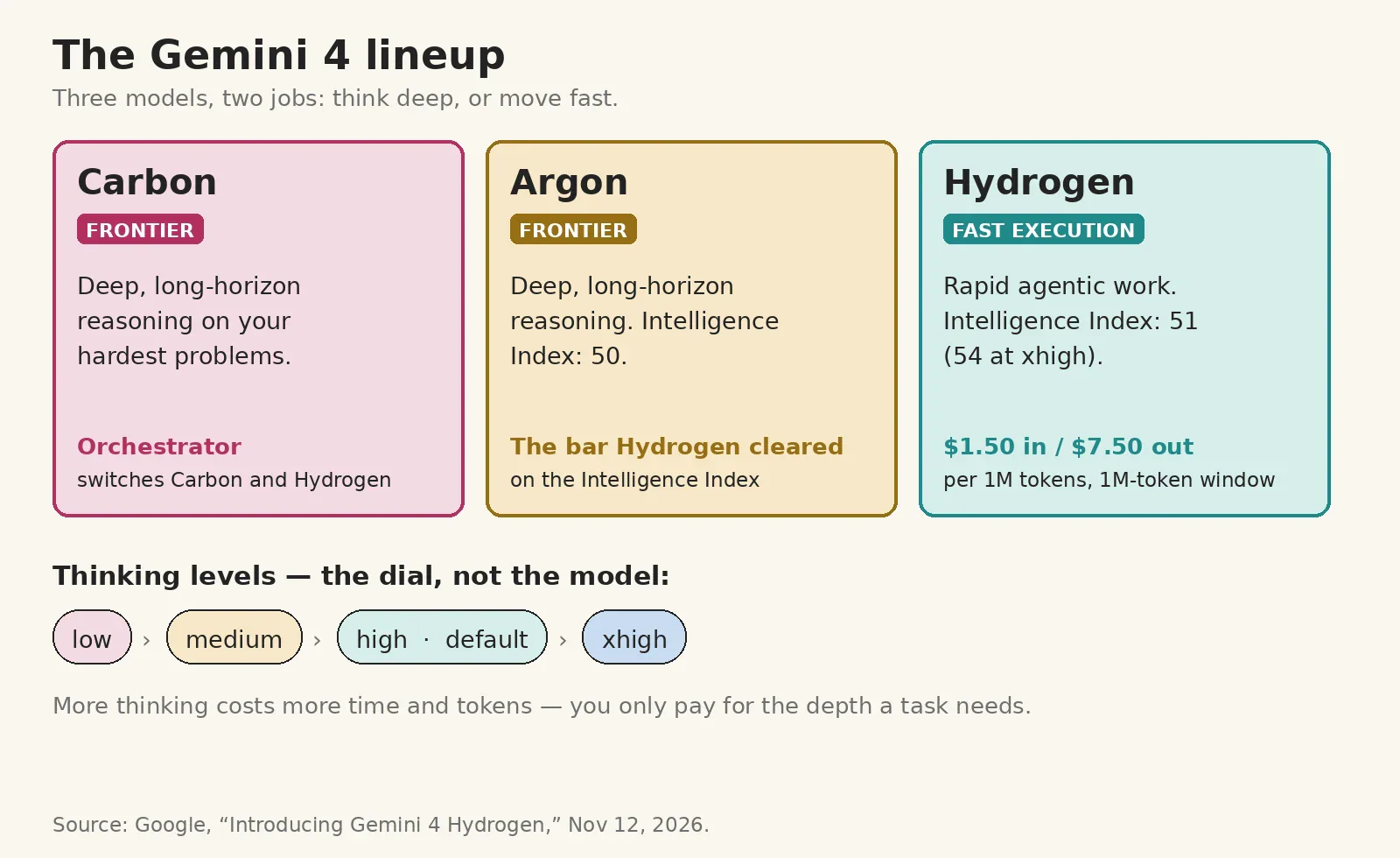
The most interesting number is the one Google buries in the middle: in Antigravity, its coding environment, a feature called Orchestrator switches between Carbon and Hydrogen inside a single session — Carbon plans, Hydrogen executes — and reaches near-Carbon task success while using 24 percent less quota and finishing 19 percent faster. That is the multi-model workflow Google is actually selling: not one model to rule them all, but a fast pair of hands directed by a slow brain.
The dial is the product
The four thinking levels — low, medium, high by default, and the new xhigh — are the part of this launch that will outlast the benchmark scores. Every model maker now ships a reasoning dial; Google's version is notable for making it the default experience rather than a buried setting, and for pricing flat across the whole context window: $1.50 per million input tokens and $7.50 per million output tokens, thinking included.
The bet is that most work does not need the deepest reasoning, and that the waste in AI today is paying frontier prices for routine execution. Hydrogen's pricing says the same thing the benchmarks do: the fast tier is no longer the compromise tier.
Search is the tell
The most consequential place Hydrogen lands is the one most people will never notice: Google Search. Hydrogen is now the default model in AI Mode and is used for the hardest questions in AI Overviews, and Google calls it the biggest model improvement to Search yet. It understands multi-part questions, survives hard-to-read typos, returns more visual responses, and fans queries out to a wider range of links.
That matters more than the developer pricing because it changes what a billion people get when they ask Google something complicated. The fast model is now the one answering your hardest question.
There is a small irony in the name. For weeks before the announcement, "Hydrogen" circulated on X as an unconfirmed codename for a leaked Gemini model, with testers reporting Hydrogen checkpoints in AI Studio and on LMArena while Google said nothing. The November 12 announcement is the first official confirmation that the model exists at all.
The fine print
A few things to keep in mind before taking the numbers at face value. The benchmark scores are Google's own except for the Artificial Analysis index, which is independent. The model card is published; Google says the full Safety & Security Report will be available in the coming days. On safety, Google reports Hydrogen reduces overreach in agentic tasks by up to 81 percent and under-service by up to 79 percent against 3.8 Flash, cuts misaligned actions by 12 times, and is more than 2.3 times more resilient to indirect prompt injection on the Gray Swan benchmark — all internal measurements, all worth watching in independent testing.
What is not in doubt is the direction: the fast model is now smart enough to be the default, and Google just made it the default everywhere it matters.