OPTIMJACK: one poisoned Optimizely snippet served malware from 178 sites
On November 16, an attacker wrote malicious JavaScript into Optimizely customer projects, and the world's biggest sites served it to their visitors — a crypto clipper, a card skimmer, and iOS exploit kits included.

On this page
In brief
- Report URI found malicious JavaScript in 188 of 1,611 Optimizely snippets, belonging to 178 organisations including Zoom, the BBC, CNN, Salesforce and GitLab.
- The attacker wrote code into the Project JavaScript field of customer projects; the snippet was still served from cdn.optimizely.com with Optimizely's certificate.
- The payload swapped crypto wallet addresses, skimmed cards typed into site forms, stole cookies and screenshots, and loaded iOS exploit kits on older iPhones.
- About $7,040 in crypto reached the attacker's wallets within nine hours; the uncounted theft is cards, cookies and screenshots.
- Only 24 of the swept sites blocked the payload — a restrictive Content Security Policy, not trust in the vendor's domain, was the defence that worked.
On Monday, November 16, visitors to some of the most trusted websites on the internet were served malware. Zoom, the BBC, CNN, Salesforce, GitLab, IKEA, HSBC, Equifax, Air France-KLM, Ledger, Peacock — 178 organisations in all, according to the researcher who found it. None of them had their own servers breached. The code arrived from a host every one of them had deliberately trusted, over a valid certificate, inside a file that looked exactly like the A/B testing snippet it had always been.
Security researcher Scott Helme of Report URI found it: his team fetched 1,611 Optimizely snippets and found malicious code in 188 of them. The payload swapped cryptocurrency wallet addresses, skimmed payment cards, stole cookies and screenshots, and on iPhones and iPads loaded iOS exploit kits. By 19:25 UTC the attacker's wallets had received about $7,040. The campaign is now called OPTIMJACK; no threat actor has been named.
The field anyone could write to
Optimizely Web has each customer load a JavaScript "snippet" from its CDN, typically cdn.optimizely.com. The snippet carries Optimizely's code, the customer's experiments, and an optional Project JavaScript field — custom code that runs on every page.
The attacker wrote code into the Project JavaScript of customer projects; the rest of each snippet was untouched, still served from cdn.optimizely.com with Optimizely's certificate. The loader came in three versions: a plain script tag pointing at https://1688360.cc/track.js, the same address hidden in base64, and a full inline copy that runs through eval if the attacker's server is blocked.
Optimizely's own sites were hit too — the snippets for www.optimizely.com and login.optimizely.com both carried the code — as were customers serving it from their own domain. The CDN served exactly what it was given, so this was not a cache-poisoning attack. Neither Helme nor Optimizely has explained how the attacker got write access to so many unrelated customer projects. Optimizely told BleepingComputer that "an unauthorized party exploited a vulnerability in the Experimentation account signup flow." It has not explained how a signup-flow flaw reaches other customers' projects.
Four thefts in one file
Every visitor got the same script, track.js, with every part active at once. The attacker rebuilt it 26 times during the day.
First, crypto address swapping. The script finds valid wallet addresses — Bitcoin, Ethereum and other EVM chains, TRON, Solana, TON, Litecoin, Bitcoin Cash, Dogecoin — validates their checksums, and replaces them with the attacker's — in page text, form fields, links, clipboards, and outgoing requests.
Second, card skimming, added at 13:43 UTC. The script watches form submissions and network requests for a card number — Luhn-checked — plus expiry date and CVV, and sends all three to the attacker's server. Hosted payment iframes, such as Stripe or Adyen, were out of reach; a site's own form fields were not. When it swaps an address next to wallet or payment wording, it also sends the page URL, non-HttpOnly cookies, the original addresses, and a page screenshot back to the attacker.
Third, on iPhones and iPads, the script loads boot.js from two router domains, which read the iOS version and pick an exploit chain in a hidden iframe: Coruna for iOS 13 to 17, DarkSword for iOS 18, and a fingerprinting-only chain for iOS 26.
The money is the only theft that can be counted. Helme's tally at 19:25 UTC was about $7,040, most of it 0.08298 BTC (about $5,380); an update the next morning put the total at roughly $7,151.
Seventeen hours, in the open
The first injection Helme's team saw was at 04:21 UTC on November 16, in the BBC's snippet, loading an earlier injector from webshell.lol. The first build of track.js appeared at 08:10 and the card skimmer at 13:43. Helme's sweep between 19:24 and 19:59 found 186 of 1,611 snippets infected. A mass clean-up ran from about 20:40 to 21:10; by 21:52 only TalkTalk's snippet still carried the code, and by 23:11 UTC all were clean.
The same injector had already run through Kissmetrics, StorifyMe and Minute Media scripts in the days before, and one wallet had been in use since March 2026. Monday was the day the operation scaled up.
The allowlist was the vulnerability
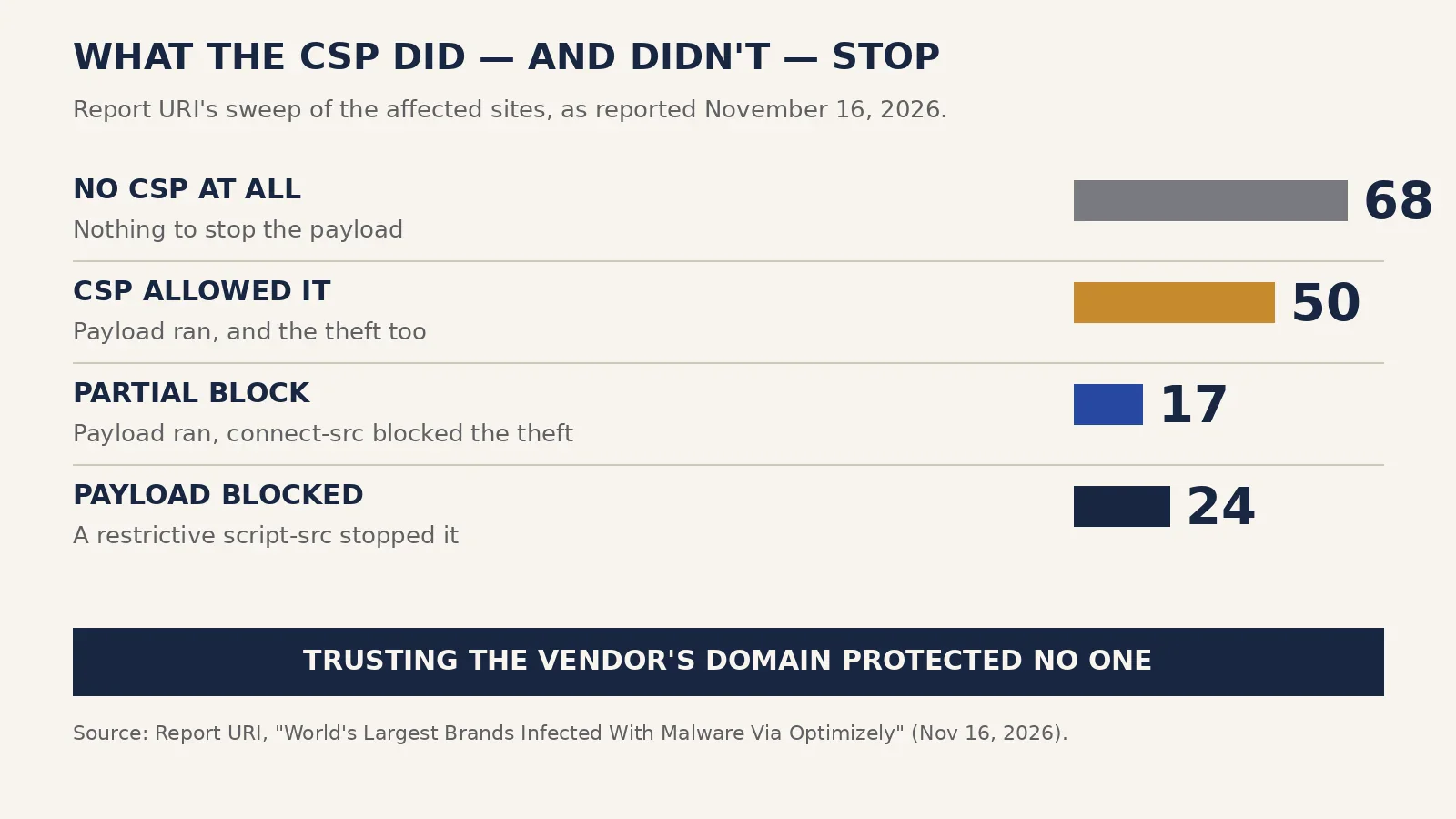
Helme's team also checked what protected the sites it swept. Of the affected organisations, 68 had no Content Security Policy at all. In 50, the CSP in place allowed the payload and the data theft. In 17, the payload ran but connect-src blocked the theft. In 24 — about 15 percent — the CSP blocked the payload outright.
Allowing cdn.optimizely.com was never going to help — the code arrived from the trusted host itself. What separated the 24 was a restrictive script-src: a site that lists only the hosts it needs blocks 1688360.cc. Two common settings let it through: 'strict-dynamic', which trusts any script the trusted snippet inserts, and 'unsafe-eval' — which Optimizely's docs tell customers to allow — which let the inline fallback run even where track.js was blocked. That is what happened at HSBC.
connect-src mattered too: the 17 "partial" sites blocked the theft by restricting where the page can send data — but not address swapping, which happens inside the page. The defence that worked was assuming the vendor's domain could be turned against you.
What Optimizely has — and hasn't — said
Optimizely posted on its status page at 01:02 UTC on November 17, and on X at 01:21, saying it had "identified and contained a security incident affecting some Optimizely Web Experimentation customers" and that "the vulnerable path is blocked, the injected code was removed, and customers have been contacted directly." It added that it had ended sessions, revoked tokens, reset access, and blocked the code at Cloudflare. As of November 17 the status page entry was still in "Monitoring" and the investigation ongoing.
What it has not published is a technical description of the flaw, a count of affected projects — its notice gives no number against Report URI's 188 — or an explanation of how a signup-flow flaw gave an outsider write access to other customers' projects.
What to check
If you visited an affected site on November 16: update your iPhone or iPad to iOS 18.7.3 or later, or iOS 26.3 or later. Check any crypto transfer you made — if the pasted address does not match the one you meant to pay, it may have been swapped. Watch your card statements if you paid by card there.
If your site uses Optimizely Web: open every project's Project JavaScript and every experiment's custom code and look for 1688360.cc, atob( and any script you did not write. Review who has write access to your Optimizely account and rotate credentials. Treat cards entered on November 16 as exposed, and rotate session tokens in non-HttpOnly cookies. Deploy a CSP, restrict connect-src, avoid 'unsafe-eval' where you can, and turn on reporting.
The attacker only needed write access to a field the platform is designed to let customers edit. Any service that can push code into your pages is part of your production — and its access controls are yours, whether you audited them or not.