OpenAI's GPT-6.2 bargain was a billing error — limits now arrive 40% sooner
OpenAI undercounted GPT-6.2 Astra and Sol usage since launch. The fix means the same work eats more of your allowance, and every paying account gets one banked reset.
On this page
In brief
- OpenAI fixed a billing error that had discounted GPT-6.2 Astra and Sol usage since the November 17 launch; the same work now uses more of your plan's allowance.
- Limits arrive 40% sooner on Astra and 25% sooner on Sol, compared with last week. Other models are unaffected, and OpenAI will not charge for past usage.
- Every Go, Plus, Pro and Business account gets one banked reset: a one-time refill you save until an allowance drops below 80% remaining.
- Work and Codex share one allowance with a five-hour and a weekly window; the same usage counts against both, so a fresh five-hour window does not unblock a spent weekly one.
- In December, Plus, Pro and Business move to one token-based allowance shared across ChatGPT and Codex. OpenAI has not said how large the combined budget will be.
If GPT-6.2 felt generous last week, that was the bug. OpenAI admitted on Thursday that a billing error at the launch of its GPT-6.2 Astra and Sol models had discounted usage for most subscribers, so the same work consumed less of a plan's allowance than it was supposed to. The company has fixed the metering, and the same work now costs more allowance: limits arrive 40 percent faster on Astra and 25 percent faster on Sol, compared with last week.
Thibault Sottiaux, who works on Codex and ChatGPT at OpenAI, announced the fix in a post on Thursday, first reported by Business Insider. "We made a billing mistake at launch of GPT-6.2 that incorrectly discounted GPT-6.2 Astra and Sol usage for most users," he wrote. "We've fixed this now, so the same work will use more of your plan's usage allowance." OpenAI will not charge anyone for the difference on past usage, and other models are unaffected. As compensation, every account on Go, Plus, Pro and Business gets one banked reset, a one-time refill of the allowance.
The promise the bug was flattering
The timing is awkward for OpenAI, because the launch sold efficiency. When Astra and Sol arrived on November 17 in ChatGPT Work and Codex, OpenAI said both models "deliver better results on demanding tasks with fewer output tokens, so you can get more done within your usage limits." Astra's API token prices are 20 percent lower than its predecessor, GPT-6 Astra, and on the company's Agents' Last Exam benchmark it scored 5.2 points higher at less than a third of the cost. For nine days, subscribers had reason to believe the models went further on the same money. Part of that distance was a metering error, not the model.
Sottiaux maintains that both models should still offer more effective usage than their predecessors, GPT-6 Astra and GPT-6.1 Sol. The comparison is now less flattering than it was nine days ago, as Decrypt put it. Some replies to his post were unconvinced, and several users said they would switch to Gemini or Claude, according to Notebookcheck. Astra is the flagship of the pair: the previous Astra led ShellBench, completing 62.5 percent of everyday agent tasks, the best of the 12 models tested.
One way to read the numbers: Decrypt notes that if a particular amount of work consumed 50 percent of your allowance last week, it would consume 70 percent or more today on Astra, assuming the percentages describe the rate of consumption. OpenAI has not spelled out how many fewer tasks will fit, and the percentages alone do not say. What they do say is that the discount is gone, and the models now cost what OpenAI intended them to cost all along.
One allowance, two clocks
A ChatGPT subscription does not buy a number of messages. It buys an allowance, and for the Work and Codex surfaces that allowance is shared: ChatGPT Work, Codex and the other agentic features draw from one pool. On Plus and Business Standard, the allowance runs on two clocks at once, a five-hour window and a weekly window, and the same usage counts against both. Where both limits apply, you need allowance left in both to keep working.
OpenAI publishes estimates of what a five-hour window holds: 6 to 50 local messages with GPT-6.2 Astra on Plus, and 17 to 180 with Sol. Those are estimates, not fixed limits, and the pricing page gives no indication whether the rows were revised after the fix: the numbers on the page today are the same ones published before it. Cloud tasks can use more of the allowance than local messages, and the weekly window has no published size. The dashboard in Settings, then Usage, is the only number that counts for your account.
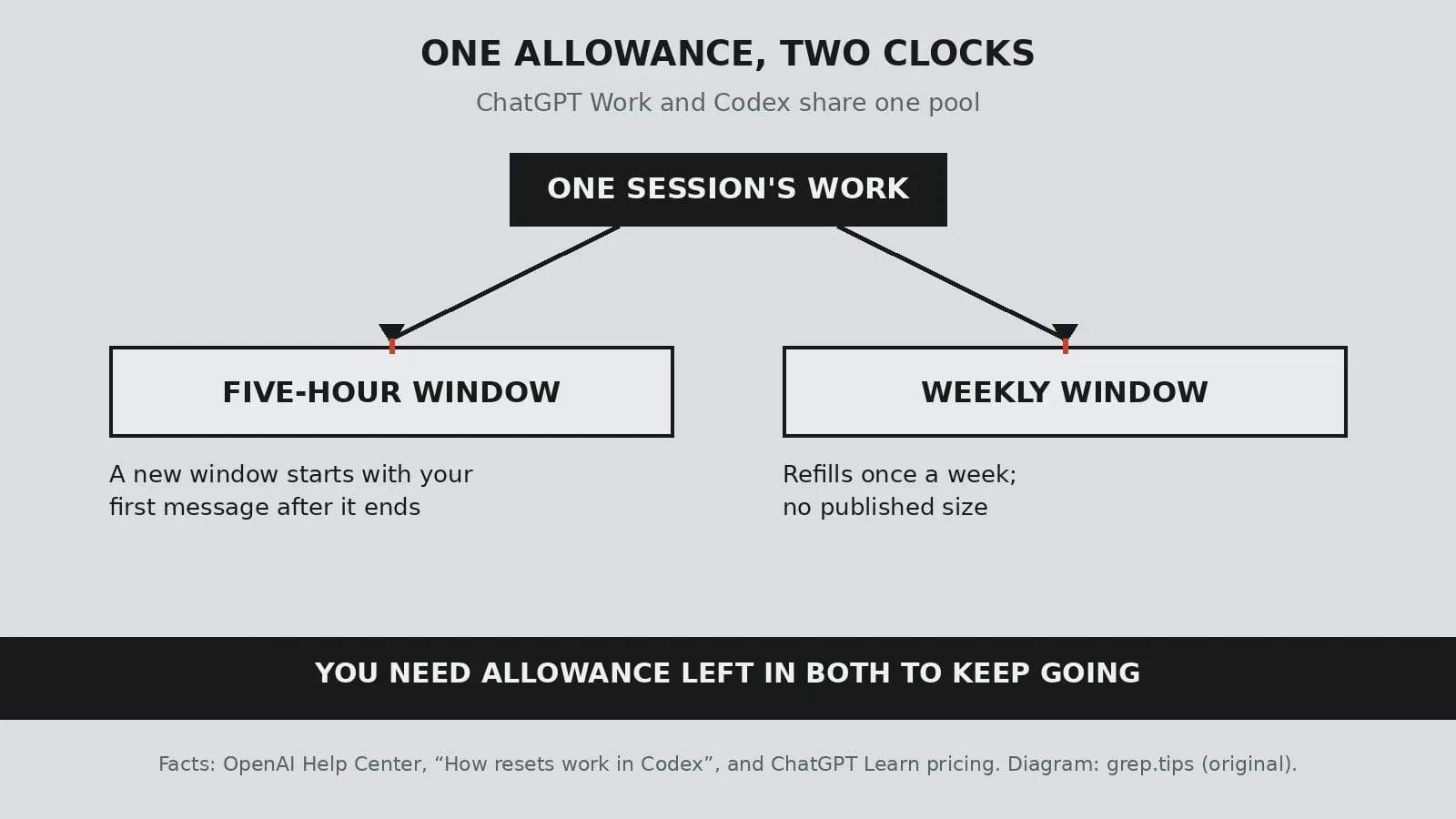
Two details from OpenAI's own pages matter when you hit the wall. A new five-hour window starts with your first message after the old one ends, so the clock follows your use, not the wall clock. And if you reach a limit in the middle of a turn, the agent can finish that turn, subject to fair use limits. What the windows do not do is rescue each other: a fresh five-hour window is no help if the weekly one is spent.
Free users are outside all of this. Neither model is available on the free plan, so nothing changes for them. Sottiaux also said nothing about the regular Chat tab, where a version of Sol has powered conversations since November 23, and OpenAI has not confirmed whether message limits there will change.
The banked reset, and how to spend it
A banked reset is a free, one-time reset saved to your account. Receiving one does not refresh your usage. You choose when to use it, before it expires. On Plus and Business Standard it restores the five-hour and weekly allowances to 100 percent. On Go it restores the monthly allowance. On Pro it restores the weekly allowance. It does not permanently raise your limits, and it does not touch image generation, file uploads or regular Chat voice.
It only works when you actually need it. At least one covered allowance must have less than 80 percent remaining, or the reset stays saved. Redeem it on the web in Usage settings, in the desktop app under Settings, then Usage and billing, or in the Codex CLI with /usage. The mobile app has no reset controls. Each reset carries an expiry date, shown before you confirm, so the sensible move is to save it for a day you are close to the limit. OpenAI has not said when the reset will appear on accounts.
One reset buys back a day, not the old rate. Once it is spent, the same work still eats allowance faster than it did before the fix, and there is no second one coming from this apology.
December changes the meter again
Separate from the fix, and larger in the long run, is the change coming in December. Plus, Pro and Business plans will share one token-based allowance across ChatGPT and Codex, with Instant chat left outside it. A small group of Pro subscribers has been on the shared meter since November 24, Notebookcheck reports, citing TechCrunch. OpenAI expects most users will not have to wait for a reset more often than they do now.
The size of the combined budget is still undisclosed. OpenAI did not answer Decrypt's question about whether the combined allowance will be less than the usage people enjoy across Chat and Work today. The billing correction and the merger are separate changes, but they land on the same subscribers in the same weeks: first the meter runs faster, then the meter gets shared.
What to do now
Check Settings, then Usage, and read both meters before you assume a limit is a bug. Save the banked reset for a day an allowance is nearly spent, since it only redeems below 80 percent remaining. Move routine work to Sol, which OpenAI estimates at 17 to 180 local messages per five hours against Astra's 6 to 50, or to Instant chat, which sits outside the December allowance. OpenAI's own advice for stretching an allowance is unglamorous and specific: shorter prompts, fewer source files attached, a smaller AGENTS.md, and MCP servers switched off when they are not needed.
The reset is a one-time refill. The corrected meter is the new normal, and the number that decides how December feels, the size of the shared allowance, is still unpublished.