One breached AI vendor, three blast radii: how the Fireworks chain reached Cursor and Notion
A key exposed at Fireworks AI unlocked Cursor's agent traces and a tampered Claude Code extension, while Notion's AI chats leaked through the same breach — one vendor, three blast radii.
On this page
In brief
- Cursor says an attacker obtained an access key it had issued to Fireworks AI, then used it to copy historical coding-agent traces from a shared bucket.
- A few traces held unredacted credentials — fewer than 0.01% of customers had API credentials exposed — and the attacker reached Cursor's internal tools.
- On October 29 the attacker placed tampered copies of Anthropic's Claude Code extension 2.1.312 and 2.1.313 on Cursor's marketplace cache; at most 5,000 users may have received them.
- The same Fireworks breach exposed Notion AI chat transcripts from fewer than 1% of workspaces, via data stored for the Insights feature.
- Zero data retention covered Fireworks' inference services, not the stored datasets, billing records, and traces that actually leaked.
The chain, in one paragraph
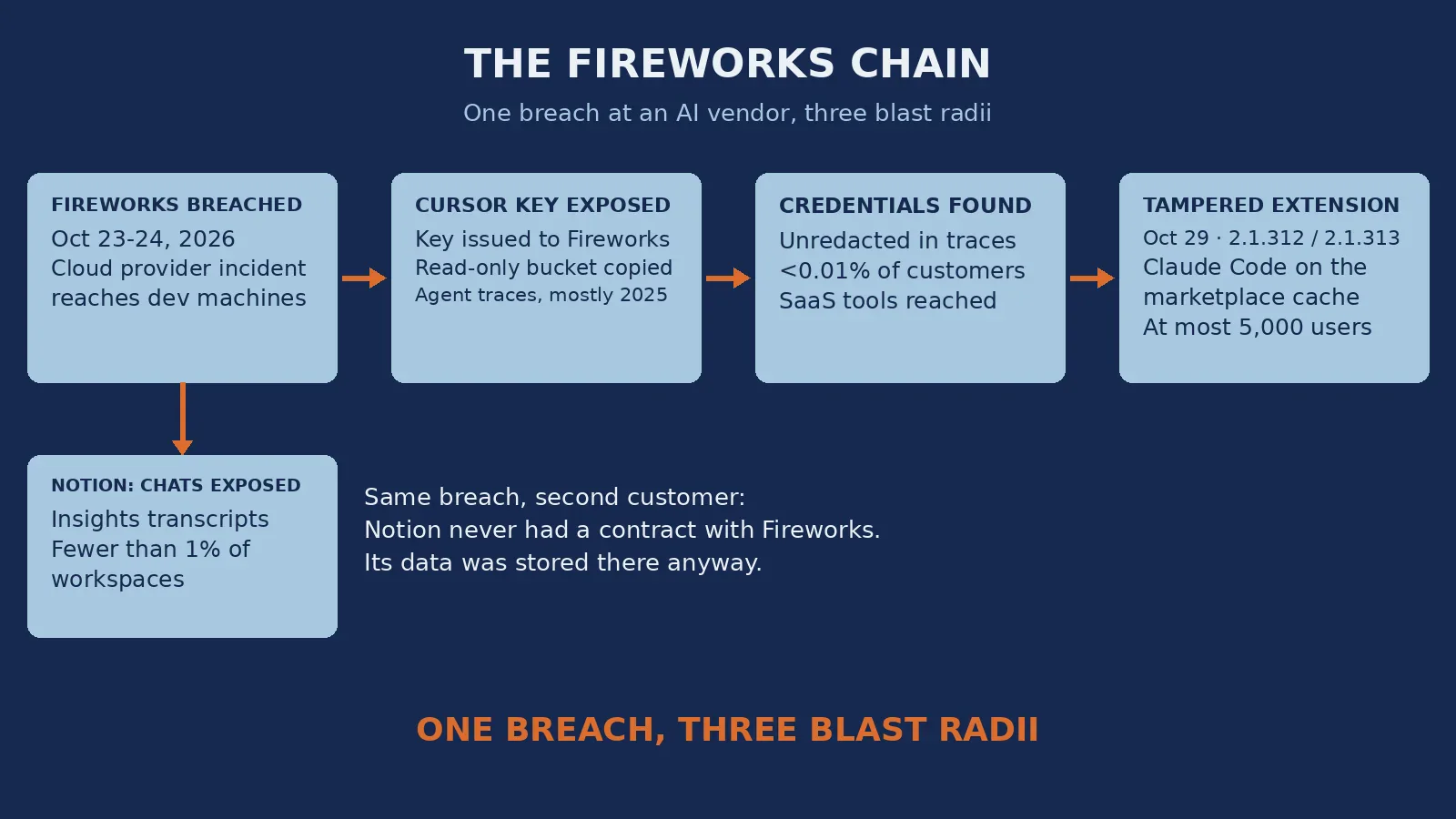
On November 13, Cursor published the missing link in a story that began a month earlier at a company most users had never heard of. An attacker obtained an access key Cursor had issued to Fireworks AI, the vendor that ran some of Cursor's models. The key — Cursor says it was "exposed by Fireworks" — opened a shared bucket of historical coding-agent traces, a few of which still held unredacted credentials. The attacker used them to reach Cursor's internal tools, and on October 29 placed tampered copies of Anthropic's Claude Code extension in the cache serving Cursor's extension marketplace. At most 5,000 users may have received the malicious build in the roughly 11 hours it was live. The same Fireworks breach also exposed Notion AI chat transcripts from fewer than 1% of Notion workspaces.
What Fireworks says happened
Fireworks' October 9 bulletin described unauthorized use of internal credentials and access to secrets stored for evaluation jobs.
The picture widened in stages. On October 23, a third-party cloud provider hosting Fireworks' research and development machines had a security incident of its own; on October 24, the attacker used that foothold to reach Fireworks' development machines and run an unauthorized workload. Fireworks says it detected the activity the same day, with no further unauthorized access on the customer platform as of October 25.
Its November 9 update added account and billing information — addresses, invoice and payment history, account balance, credit usage — and, for a limited set of accounts, secrets, datasets, and incomplete model weights. Payment card numbers were not stored and were not impacted, the company says. It also says it has detected no impact to its Inference, Training SDK, and Nexus services, which are zero data retention by default, though the investigation is ongoing. Fireworks links the activity to a financially motivated group selling tokens from unauthorized model access via illicit routing gateways — a pattern known as LLMJacking.
How the key became a marketplace attack
"An attacker obtained an access key we had issued to Fireworks. The key was exposed by Fireworks," Cursor wrote, and used it to copy data from a read-only storage bucket the two companies used to share data. The bucket held limited coding-agent traces, mostly from 2025, from sessions not in Privacy Mode, which Cursor was permitted to use for model training. A few traces contained unredacted credentials — fewer than 0.01% of customers had API credentials exposed, and traces for fewer than 0.05% of non-Privacy-Mode users.
From there, the attacker reached select SaaS tools Cursor used, and accessed archived non-production source code, limited support data, and usage metrics.
On October 29, using a stolen credential, the attacker placed malicious copies of Anthropic's Claude Code extension — versions 2.1.312 and 2.1.313 — on the cache serving Cursor's VS Code extension marketplace. Anthropic did not publish these copies, Cursor stresses; this was not a vulnerability in Anthropic's product, and the marketplace source, Open VSX, never had the malware. At most 5,000 users who requested those cached versions on October 29 may have received the malicious build. It was live about 11 hours before Cursor removed it and took the marketplace offline.
Cursor published a security notice on October 30, says the last attacker activity was on November 1 and was blocked, and has moved all inference off Fireworks, deactivated the key, and cut off Fireworks' access to shared datasets.
Two caveats: the claim that the key was "exposed by Fireworks" is Cursor's — Fireworks' bulletin does not mention Cursor — and neither company says when the key was taken, so it is not established that the October 24 intrusion is where it was exposed.
Notion, two links down the chain
Notion used the vendor to serve open-weight models inside its product, and for classification jobs behind Insights, which shows administrators how their teams use Notion AI.
Notion's advisory, first published November 9, says the dataset Fireworks confirmed on November 8 included Notion AI chat transcripts used for Insights. Notion says fewer than 1% of workspaces were affected, and that for the vast majority the transcripts were "unattributable" — not labelled with who wrote them or which workspace they came from, and without tool call results. A transcript with no name on it can still contain a pasted password or a customer list.
Fireworks told Notion on November 2 that a small dataset had been accessed; Notion determined it held only synthetic test data. Notion disconnected on November 3 and deleted all its data there on November 4. On November 6, Fireworks said malicious actors may have accessed potential customer data; the final dataset was confirmed on November 8, and Notion contacted impacted customers on November 9. Insights is disabled, and Notion no longer serves open-weight models through Fireworks.
Why "zero data retention" didn't cover it
The uncomfortable detail is what zero data retention did and did not protect. Fireworks says its inference, training, and Nexus services are zero-retention by default, with no detected impact there. But the data that leaked — billing records, datasets, incomplete model weights, Notion's Insights transcripts, Cursor's shared bucket of traces — lived outside those services, in storage and evaluation systems where retention was the point.
A zero-retention promise usually covers the inference call: the prompt goes in, the answer comes out, nothing is kept. It rarely covers the copies kept to measure usage, train models, run evaluations, or debug. Cursor's traces were stored in a shared bucket precisely so Fireworks could use them for training. Notion's advisory never explains why the Insights transcripts were still stored at Fireworks at all.
What to check if you used these tools
If you installed Anthropic's Claude Code extension 2.1.312 or 2.1.313 from Cursor's marketplace on October 29, follow Cursor's October 30 security notice — uninstalling alone may not be enough, Cursor says. Privacy Mode users' prompts and code were not affected, Cursor says; others who got no notification were not in the exposed traces.
If Notion contacted you, treat the affected chats as exposed and rotate any password, API key, or credential pasted into Notion AI. If not, the company says no action is needed right now.
The lesson: your vendor's vendor is your vendor
Count the hops: a cloud provider's incident reached Fireworks' development machines; Fireworks' breach exposed a key Cursor had issued it and transcripts Notion had stored with it; the key opened a bucket, the bucket yielded credentials, and the credentials opened internal tools and a marketplace cache. At no point did the attacker need to breach Cursor or Notion directly.
That is a fourth-party breach: the vendor you chose was breached through a vendor it chose, and your data sat in the systems of a company you never signed a contract with. The defenses are unglamorous — keys scoped to minimum vendor access, credentials scrubbed from traces before sharing, datasets deleted when the feature is done, and a retention promise covering storage, not just inference. Fireworks, Cursor, and Notion are all now doing versions of exactly that.