Flipper One raised $17 million for a pocket Linux computer that isn't finished yet
Flipper One, a pocket Linux computer from the makers of the Flipper Zero, raised $17.2 million on Kickstarter in eight days. The device is real, the funding is real, and so are the caveats.
On this page
In brief
- Flipper One launched on Kickstarter on November 17 and raised $17,228,333 from 31,563 backers by November 25, 57 times its $300,000 goal; the campaign runs to December 17.
- It is a pocket Linux computer for IP networking, not a Flipper Zero sequel: no NFC, RFID, or sub-GHz radio, but two Gigabit Ethernet ports, Wi-Fi 6E, and an M.2 slot for 5G, LoRa, or SDR modules.
- Two processors share the work: a Rockchip RK3576 runs Linux and apps, while a Raspberry Pi RP2350 runs the display, buttons, power, and boot, so the device stays usable even when Linux is broken.
- The 'no binary blobs' claim is an ambition, not the current state: Flipper's own blog says one closed blob remains, the DDR trainer, and the NPU and hardware video encoding are not fully upstream yet.
- The $399 price covers production costs with no profit margin, according to Flipper; the CEO has said the sustainable price is closer to $500, and the RAM could be cut if memory prices do not fall.
Flipper Devices asked for $300,000 to build a pocket Linux computer. Eight days later, 31,563 backers had pledged $17,228,333, which is 57 times the goal, with 21 days still left on the campaign.
The Flipper One is a handheld Arm computer built for networking: two Ethernet ports, Wi-Fi 6E, a small screen, and a slot for radio modules. It is not a sequel to the Flipper Zero, the pocket radio tool that made the company famous. It is a different machine for a different layer of the network, and the money says a lot of people want one. The fine print says to read the campaign page twice.
Not a sequel
Flipper draws the line in networking layers. The Zero works at what the company calls Layer 0: offline, point-to-point access-control protocols such as NFC, low-frequency RFID, sub-1 GHz radio, infrared, and wired protocols like iButton, UART, SPI, and I2C. It runs on a low-power STM32WB55 microcontroller, a dual-core Arm Cortex-M4 at 64 MHz with 256 KB of SRAM.
The One works at Layer 1: everything with an IP address. Wi-Fi, Ethernet, 5G, and satellite, plus software-defined radio and local AI. It has no sub-GHz, NFC, or RFID hardware inside. Flipper puts it plainly on the campaign page: the two are not newer and older generations of the same product, and comparing them directly would be like comparing a hammer to a screwdriver.
That distinction matters for anyone buying on the Zero's reputation. The One does not do what the Zero does. It does something else, for people who spend their time on IP networks rather than on radio protocols.
Two processors, one pocket
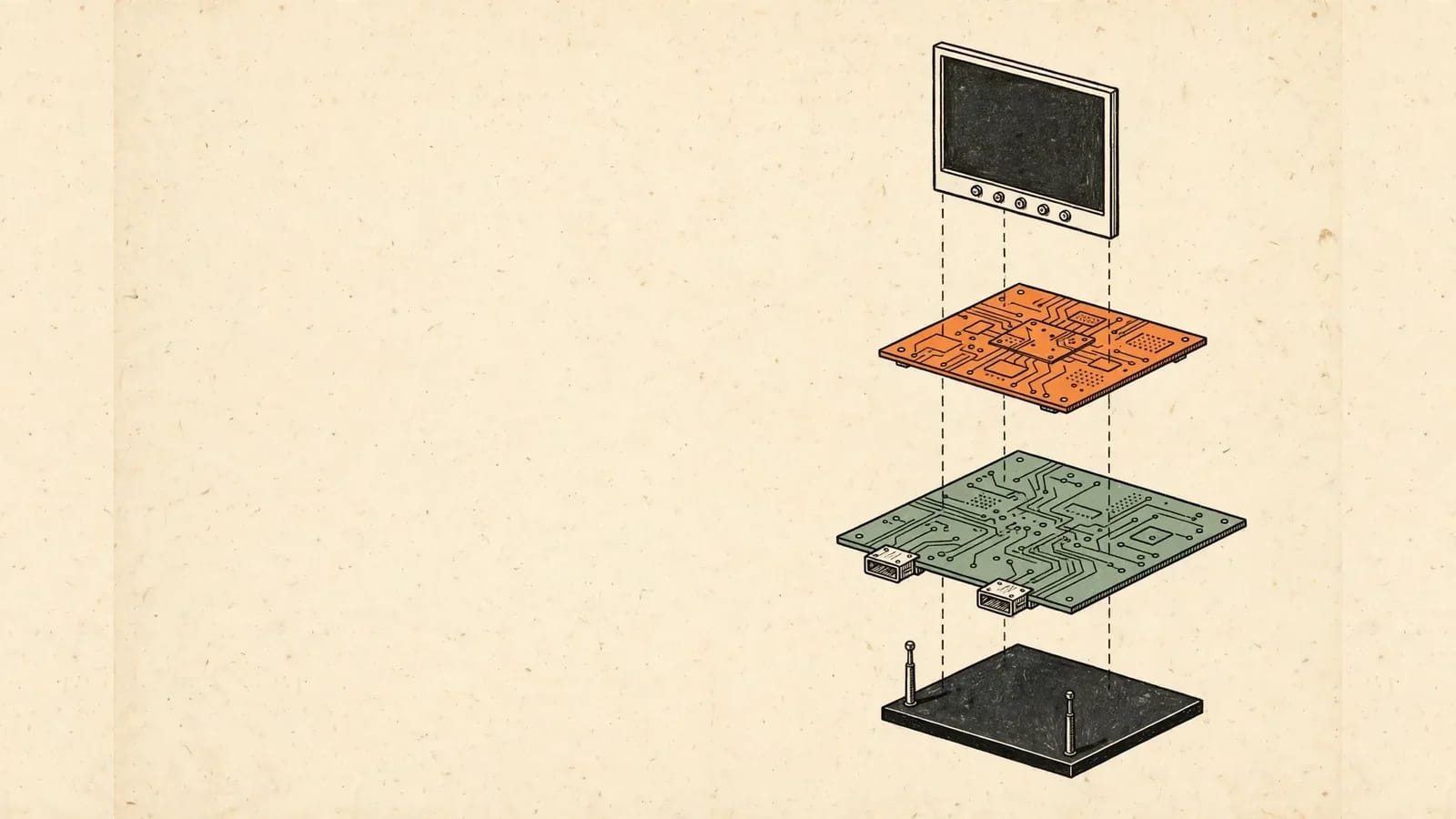
The interesting engineering choice is inside the case. Flipper One runs on two processors at once, each managing its own part of the device.
The Rockchip RK3576 is the application processor: four Cortex-A72 cores at 2.2 GHz and four Cortex-A53 cores at 1.8 GHz, a Mali-G52 GPU, a 6 TOPS neural processing unit for on-device inference, 8 GB of LPDDR5 memory, and 64 GB of UFS 2.2 storage. It runs Linux and the apps, and it manages the fast interfaces: Ethernet, Wi-Fi, PCIe, USB, and HDMI.
The Raspberry Pi RP2350 is the low-power microcontroller: two cores at 150 MHz with 264 KB of SRAM and 16 MB of flash. It runs the 256 by 144 grayscale display, the buttons and touchpad, the power subsystem, and the boot process. The two chips talk over three links: SPI carries the framebuffer to the microcontroller for display output, I2C carries commands one way and button and touchpad events back, and UART plus a few GPIO lines handle boot control.
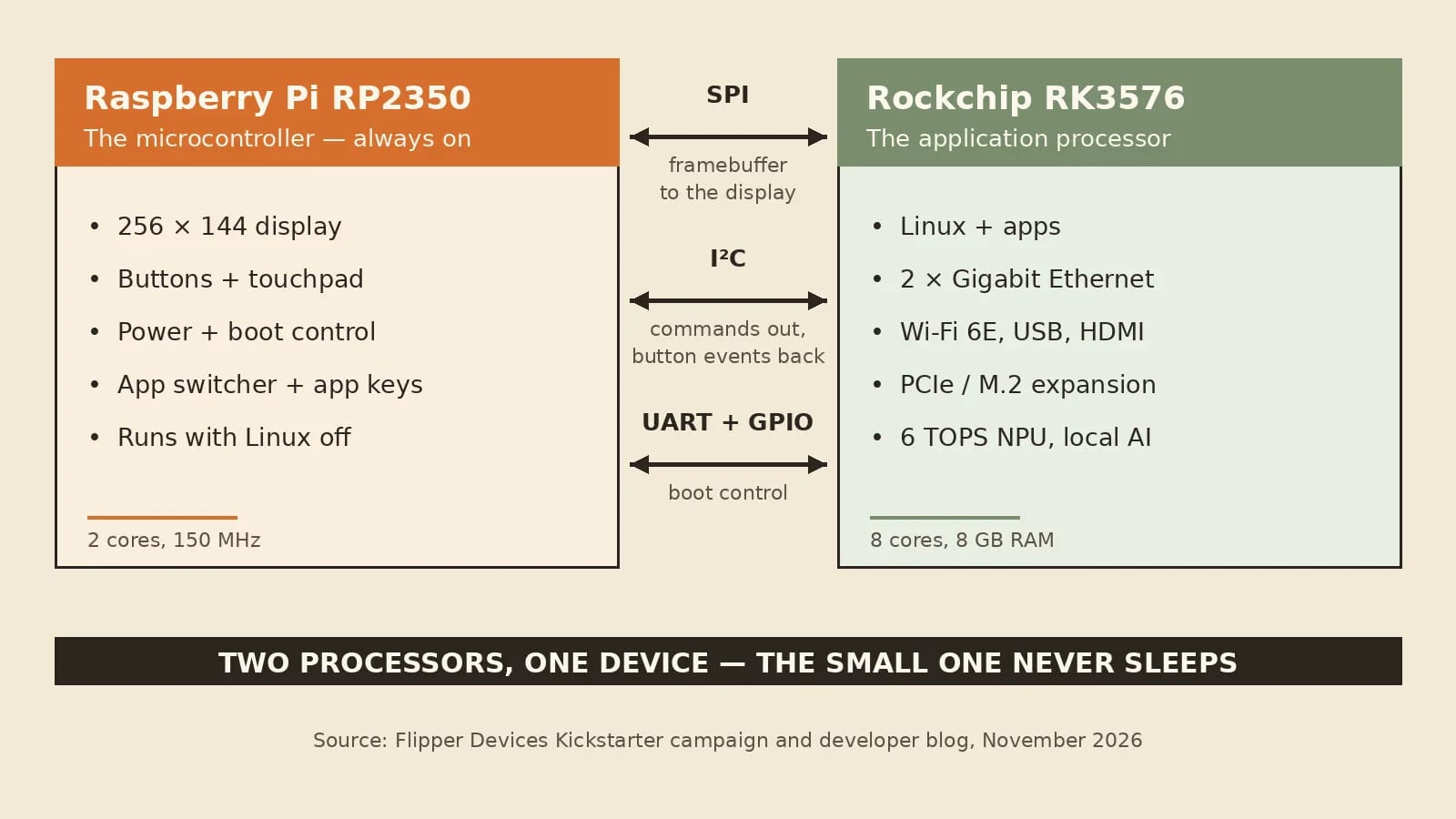
The split exists so the device stays usable when Linux does not. The microcontroller runs on its own, so the screen, buttons, and boot controls keep working even with Linux powered off or rebooting. Break the operating system completely and the device can still recover itself through the same USB-C port, using the RP2350's BOOTSEL mode or the RK3576's MaskROM mode, with no external computer and no separate debugger.
What it is for
Out of the box, the One is a network multi-tool. It can connect up to five uplinks at once and manage dynamic routing, failover, load balancing, and firewall rules. It can run as a Wi-Fi hotspot and a client at the same time, tunnel traffic through a VPN, and act as a bridge between wired and wireless networks. Built-in apps scan networks for active hosts, open ports, and misconfigurations, detect attacks, and can run as a honeypot, saving results as exportable reports.
One USB-C cable covers most of the bench work. Plug it into a laptop and it provides an SSH console while charging, emulating a USB network adapter, a serial device, or a disk drive at up to 5 Gbps. Plug it into a monitor and it becomes a desktop, with video output at 4K and 120 Hz over DisplayPort Alt Mode, while peripherals connect through the monitor's USB hub. There is also a full-size HDMI 2.1 port, a deliberate choice Flipper says was made because the team is tired of hunting for mini HDMI adapters. The company had to join the HDMI Forum to ship it.
The expansion slot is where the device gets its range. An M.2 Key-B socket takes modules that install under the back plate: a LoRa module for off-grid mesh messaging over MeshCore, Meshtastic, and Reticulum, which also works as a walkie-talkie between Flipper One units; a 5G modem based on the Quectel RM520, with four SMA antenna connectors and download speeds up to 1 Gbps; and a software-defined radio module whose specifications are not yet finalized. The same slot can also take SSDs, AI accelerators, and Wi-Fi cards. A built-in eSIM comes pre-provisioned with a Flipper SIM data plan, but it only works with a modem installed, and a physical SIM can be used instead.
The software is a Debian-based system called Flipper OS, built around profiles: full snapshots of the operating system with different packages and settings. Boot a profile, break it, and jump back to a clean copy, or switch to a different profile for a different job, without re-flashing a card. A second project, FlipCTL, wraps command-line tools like ping, nmap, and traceroute in a menu interface built for the small screen. It is still at the concept stage, and Flipper says the long-term goal is to make adding a small-screen interface to any Linux device as easy as installing one package.
Power is modest. Flipper's development log puts idle consumption at 0.96 watts with Linux running, which works out to about 24 hours on the 24 watt-hour battery, and 4.5 watts running as a Wi-Fi router, or a bit over five hours. Those are the company's own figures, and real use will pull them down.
The open claim, examined
The campaign page makes three promises about openness: mainline Linux kernel support, no binary blobs, and no vendor-locked board support package. The first and third are substantial achievements for an Arm device. Flipper partnered with Collabora to push RK3576 support into the mainline kernel, and the company says the device runs on a kernel downloaded from kernel.org with no vendor patches.
The second promise needs the asterisk Flipper itself supplies. Its developer blog, published in May, says plainly that one last binary blob remains in the boot chain: the DDR trainer, the closed Rockchip code that initializes RAM during early boot. Collabora's own post says the same. The blog also lists what is not fully upstream yet: the NPU, hardware video decoding, and other accelerators, plus power management and USB DisplayPort Alt Mode work that is still in progress. XDA's launch report adds that there is no OP-TEE support for the chip yet, and CNX Software notes that wireless firmware blobs will probably still be needed for regulatory reasons.
None of this is hidden. Flipper publishes its task trackers, internal discussions, half-finished documentation, and architectural debates in a public Developer Portal, and the blog asks the community to help convince Rockchip to open the DDR trainer. The honest reading is that "fully open" describes where the project is heading. The hardware has not arrived there yet. The campaign page's flat "no binary blobs" line is the one place the marketing runs ahead of the engineering.
The price problem
The $399 Kickstarter Special, capped at 15,000 units, is 25 percent off an estimated $550 retail price. Flipper says it covers production costs with no profit margin built in, and that RAM and UFS storage now account for more than half of the hardware cost. The $379 early-bird tier, limited to 1,000 units, sold out. Bundles run higher: $439 with LoRa, $539 with SDR, $599 with 5G, and $759 for all three. Shipping and taxes are extra, estimated at $15 to $30.
Co-founder and CEO Pavel Zhovner has been unusually candid about the arithmetic. In a video announcing pre-order coupons earlier this month, he said the company would need to sell the Flipper One for around $500 to make production financially sustainable, and that if it cannot sell enough units at a price covering its costs, it will cancel the Kickstarter before it ends. The pre-order page says the same thing in writing: a price this low is no longer economically sustainable for the full production run, and the campaign's success depends on higher-priced sales. Flipper blames the memory market, where AI companies are buying up huge amounts of DRAM and suppliers are shifting capacity to servers. CNX Software reports that the 8 GB RAM figure itself could be reduced if memory prices do not come down.
The hardware is also unfinished. Flipper One is in the pre-EVT stage, the early engineering validation step, on its third hardware revision. About 90 percent of the specifications are final, the architecture is confirmed, and all major subsystems work, according to the campaign page, but the bill of materials is not locked down and the final specifications may still change. Shipping is estimated for July 2027, to the United States, Canada, the United Kingdom, Australia, the 27 EU countries, Switzerland, Norway, Singapore, and Hong Kong.
None of that makes the campaign a bad bet on its face. Flipper has shipped crowdfunded hardware before: the Flipper Zero hit its Kickstarter goal in eight minutes in 2020 and went on to raise $4.8 million from more than 37,000 backers. But a pledge is not a purchase, and Kickstarter is all-or-nothing: backers are only charged if the campaign succeeds, and the campaign runs until December 17 at 11:00 AM EST.
The three things to check before backing are the upstreaming status, the specifications, and the price: Collabora's public list of what works in mainline rather than the "no binary blobs" headline; a spec sheet that is 90 percent final, with the RAM, the battery, and the SDR module still open; and a $399 price that funds the first batch while the retail price waits on a memory market Flipper does not control. Zhovner's own arithmetic is the number to carry into that decision. The device needs to sell for around $500 to make sense, and $399 buys the first batch.