Knuth pauses the $2.56 error bounty after 58 years
Donald Knuth has stopped accepting error reports for his books, for the first time in more than 50 years. LLM-assisted readers now send corrections faster than he can verify them, and most are duplicates.

On this page
In brief
- Donald Knuth will not look at error reports submitted after November 25, 2026, until he posts an updated list of known errors for each book; the list of books welcoming reports is currently empty.
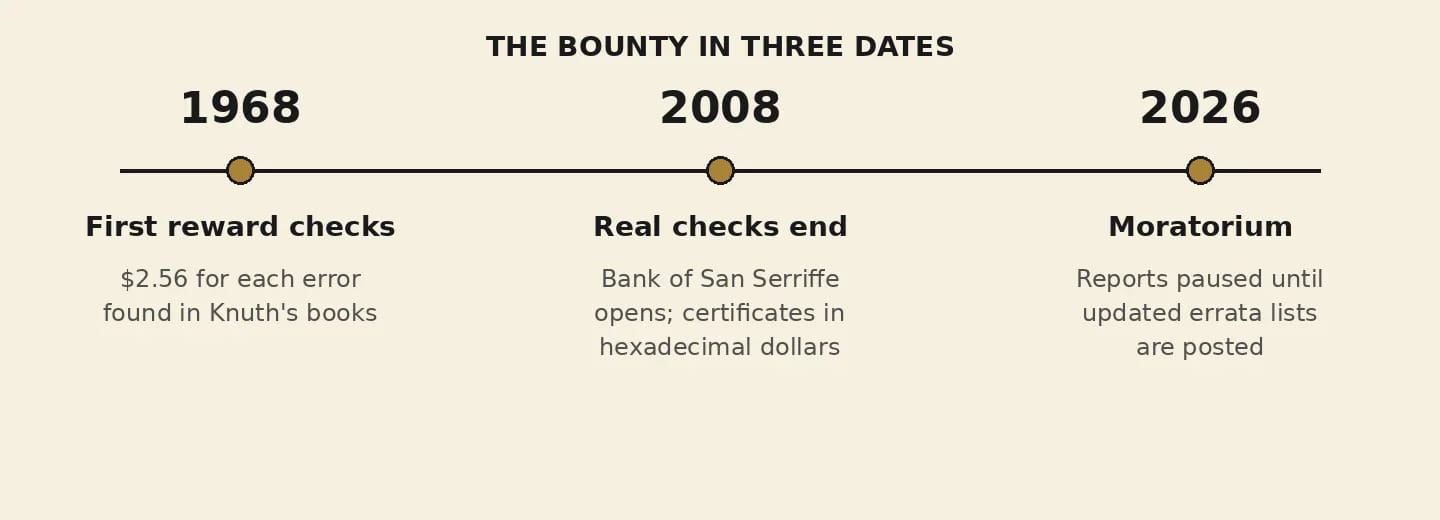
- The reward has run since 1968: $2.56, or 256 cents, to the first person to find each error, because 256 cents is one hexadecimal dollar; valuable suggestions earn 32 cents.
- Real checks ended in 2008 after check fraud forced Knuth to close three accounts; since then the reward has been a certificate from the fictional Bank of San Serriffe.
- Knuth says LLM-assisted readers now submit reports faster than he can personally verify them, and random sampling shows most recent reports duplicate ones already sent.
- The pause is temporary and per-book; Linux's networking maintainers faced the same flood this week and added a fifth maintainer.
Donald Knuth has stopped taking error reports. On a short page on his Stanford site, the 88-year-old author of The Art of Computer Programming writes that he will not look at any error report submitted after November 25, 2026, until he has posted an updated list of the known errors for the book involved. The list of books for which reports are welcome is, at the moment, empty.
That is the first time in more than 50 years that the door has closed. Knuth began welcoming error reports in 1968, after the first volume of The Art of Computer Programming appeared, and he has answered them personally ever since. The page announcing the pause is written in his voice throughout: the apology, the explanation, and the one sentence that gives the reason away.
"The rise of LLMs has increased the productivity of my readers so greatly that error reports are now being submitted much faster than I can read them!"
A hexadecimal dollar
The reward is the part everyone knows. Knuth pays $2.56 to the first person to find each error in his books, whether technical, typographical, or historical. The amount is a joke with a straight face: 256 cents is one hexadecimal dollar. A valuable suggestion earns 32 cents. For bugs in the TeX and METAFONT programs, the typesetting system and font program Knuth built, the reward started at $2.56 and doubled every year until it reached $327.68, a schedule modeled on the wheat and chessboard problem. The arrangement predates the phrase "bug bounty" by decades.
The checks themselves became a trophy. MIT Technology Review called them "among computerdom's most prized trophies," and the recipients mostly agreed: of the first 275 checks Knuth sent out after the beginning of 2006, only nine were ever cashed. The rest were kept, in Knuth's own pun, cached.
The real checks ended in 2008, for a reason that had nothing to do with the books. Criminals used the account and routing numbers printed on Knuth's checks to attack his accounts, and he had to close three of them. So the dollars became brownie points: certificates of deposit in hexadecimal dollars from the Bank of San Serriffe, an offshore institution with branches in Blefuscu and Elbonia, on the planet Pincus. The bank keeps a public ledger. As of June 21, 2026, it lists hundreds of names, their balances written in hex, the largest held by Udo Wermuth at 0x$c16.e8. The par value is printed at the bottom of the page: 0x$1 = USD 2.56.
The week the readers got faster
The moratorium page is short, and the numbers in it tell the story. Knuth insists on verifying every report himself. "This content is very important to me, and I wish to take personal responsibility for getting everything right. Therefore I insist on verifying everything carefully." That takes time, he writes, and "the amount of available time is now less than zero."
The other number is the duplication rate. Random sampling, he writes, indicates that "the vast majority of errors that have been reported in recent weeks are repeats of issues already submitted by others." That is the detail that makes the flood legible. The readers are not finding more distinct errors. Many readers, armed with the same tools and pointed at the same pages, are finding the same ones, and each of them is writing in.
Read the page carefully, and the claim is narrower than the headline version. Knuth does not say the reports are machine-written, and he does not accuse his readers of anything. He says the rise of LLMs made his readers more productive. Hacker News discussion around the page puts it more bluntly, describing the suspension as driven by AI-generated reports. Knuth's version is the one that matters: the volume outran the one person who checks everything.
A pause, not a cancellation
The pause is temporary, and it works book by book. Knuth will post an updated list of known errors for each book, and reports for that book will be welcome again once the list is up. Until then, anything submitted after November 25 waits unread. The reward itself is unchanged. A reader who finds something real should check the list first, and hold the report until the book appears on it.
The pattern is familiar from elsewhere this week. Linux's networking maintainers said they were "completely overwhelmed" by AI-generated bug reports and patches, and the subsystem gained a fifth maintainer to carry the review load. The kernel can add people to a queue. Knuth's queue has one person in it by design, and adding a second would break the promise the bounty makes: that the author himself checked it.
There is no date for the errata lists, and Knuth gives no count of the backlog waiting behind them. He apologizes twice in the same page, for having made errors in the first place and for his limited ability to cope with more than one thing at a time, and promises to work through the existing reports as soon as humanly possible. For now, the list of books welcoming errata is empty, and the instruction to readers is to wait. The bounty has survived 58 years, a check-fraud attack, and its own conversion into fictional currency. What it has not yet survived is the week its readers got faster than the man who reads them.