The code stays home: NTT's AI finds flaws without a frontier model
NTT built a vulnerability-hunting AI that runs entirely inside your own environment — and on CyberGym it went from 48% to 63% success without a bigger model. The gain came from the workflow, not the weights.

On this page
In brief
- NTT announced a cybersecurity AI that analyses vulnerabilities inside an organisation's own environment — no source code sent to an external AI service.
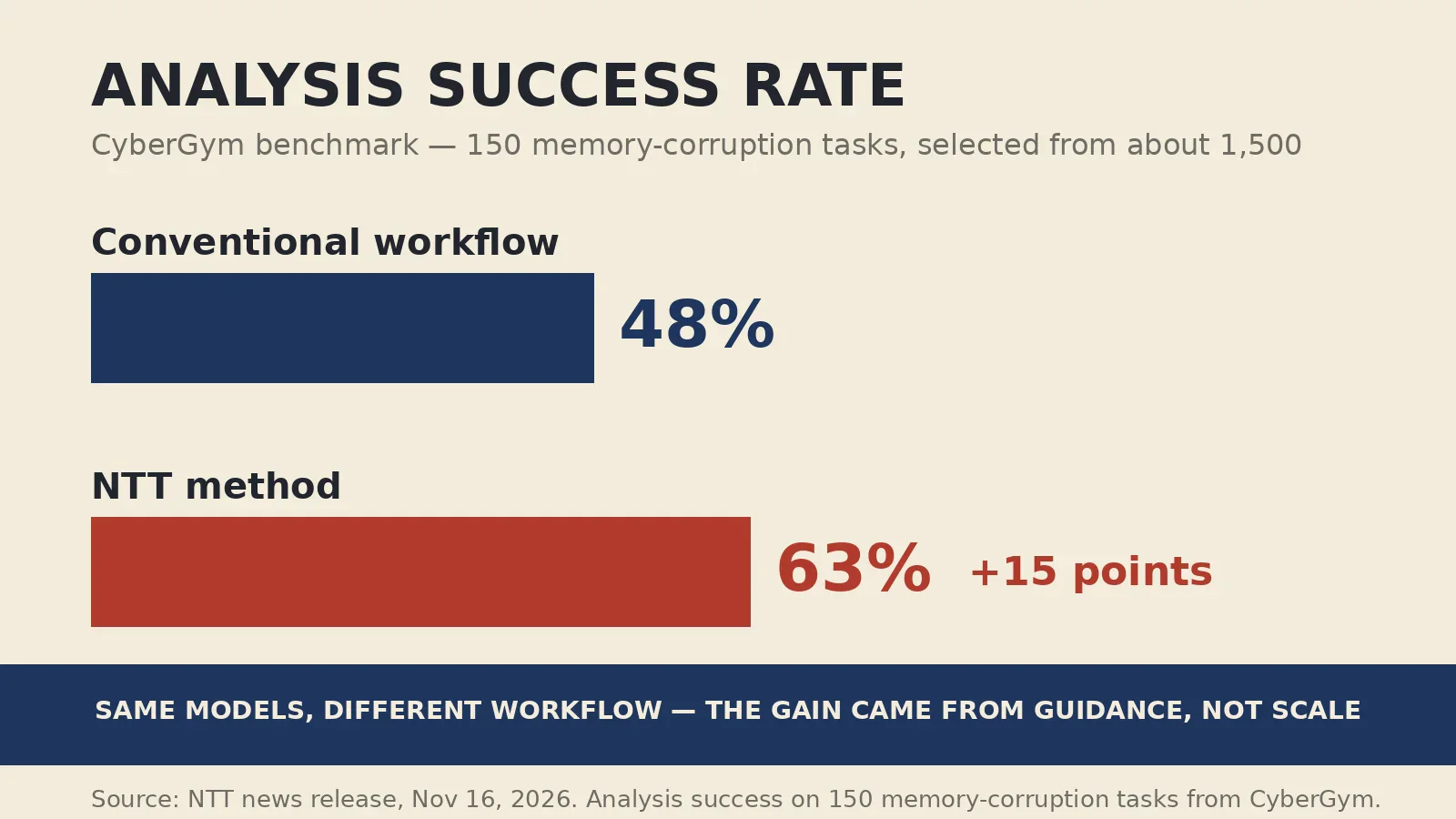
- On 150 memory-corruption tasks from the CyberGym benchmark, analysis success rose from 48% with the conventional workflow to 63% with NTT's guided workflow.
- The gain came from workflow design — expert guidance on where flaws arise — plus combinations of mid-sized open-weight models, not a bigger frontier model.
- The 63% figure is NTT's own result on one vulnerability class; the models, hardware and compute budget were not disclosed, and no head-to-head with a frontier model was published.
- Next: end-to-end support from discovery through triage to remediation; the research is on show at NTT R&D FORUM 2026, Nov 18–25. It is research, not a product.
There is a catch to using a frontier AI to hunt for vulnerabilities in your code: you have to send the frontier AI your code. For a bank, a government agency, or anyone whose source is the crown jewels, that is the whole problem. The best vulnerability hunter in the world is useless to you if using it means handing over the thing you are trying to protect.
NTT's answer, announced Monday, is to stop chasing the biggest model and fix the process instead. The Japanese telecom group says it has built a cybersecurity AI that analyses vulnerabilities entirely inside an organisation's own environment — no source code sent to an external AI service — and that it beats the conventional approach on a standard benchmark. On 150 memory-corruption tasks from CyberGym, the system succeeded 63% of the time, up from 48% with the existing workflow. The models are open-weight ones, run on the organisation's own hardware; the improvement, NTT says, came from teaching the workflow what to look for, not from a bigger model.
What "sovereign" means here
NTT calls the technology "sovereign-type, approaching frontier AI." Sovereignty, in this context, is not a marketing word for on-premises. It means the organisation chooses the model, runs it, and keeps the data — the code under inspection never leaves the building. NTT names three reasons that matters: confidential information sent to an outside service, usage costs that rise with every scan, and dependence on a single provider's service and terms.
The instinct is spreading. Four days earlier, Anthropic opened a private beta of self-hosted Claude Managed Agents, moving its whole agent service inside customers' own infrastructure, with model calls still going to a provider of the customer's choice. Different product, same diagnosis: the organisations with the most to protect are the ones least willing to ship their crown jewels to someone else's cloud. NTT's version applies that diagnosis to the defensive side of security — not the agent that writes your code, but the agent that reads it for flaws.
How the workflow beats the model
To see why the gain matters, it helps to know how AI vulnerability discovery works. The model reads a program, forms hypotheses about where a flaw might be, and then tests them — work close to what a human expert does during an investigation, except the AI runs it autonomously and in parallel, at scale. That is the whole trick — and the whole problem: the result depends on how the search is organised, not just on how smart the model is.
NTT's point is that the search is where the leverage is. Vulnerability analysis, the company says, is shaped as much by the workflow — the steps that decide what gets examined, in what order, and how a hypothesis gets verified — and by the verification tools as by the model itself. So instead of a bigger model, NTT built guidance into the workflow: pointers from its own vulnerability research, telling the AI where flaws tend to arise, so the model's effort lands where it counts.
The result is the chart below: the same analysis, the same benchmark, fifteen points better. NTT flags a second finding that matters as much: the team ran the evaluation with open-weight models of different sizes, and combining mid-sized models could lift performance too — a path to practical accuracy that does not depend on the largest models at all.
What 63% does and doesn't prove
Sixty-three percent sounds like a verdict. It is a measurement, and it comes with edges worth knowing.
First, it is NTT's own number, on a slice of one benchmark: 150 tasks, all memory corruption, selected from the roughly 1,500 tasks in CyberGym, the UC Berkeley benchmark that tests whether AI agents can reproduce real-world vulnerabilities. Memory corruption is a real and important class of flaw — the buffer overflows and use-after-free bugs behind many serious CVEs — but it is one class. The number says nothing about performance on, say, authentication flaws or injection bugs.
Second, "analysis success" is not a fix. In CyberGym's terms, the agent has reproduced and understood the vulnerability. Turning that into a patch that does not break anything else is a separate job, and NTT's announcement does not claim it.
Third, NTT did not name the models it used, the hardware they ran on, or the compute budget. "Practical accuracy without large-scale models" is the company's claim; without those details, the cost of running it is still an open question.
And "approaching frontier AI" is NTT's framing, not a head-to-head result. No comparison against a named frontier model was published, so the honest reading is narrower: on this benchmark slice, a guided workflow with open-weight models closed much of the gap that used to require a frontier service.
For scale, the benchmark's own authors found the same shape of problem. In CyberGym-E2E, published in June 2026, the strongest agents fixed about 80% of vulnerabilities when handed the flaw — but when they had to discover it themselves first, end-to-end success fell to 19.2% for Claude Opus 4.5 and to between 37% and 66% for the newest models. Finding the flaw is the hard part. That is exactly the part NTT measured, and 63% on a selected subset sits inside that range — respectable, and a long way from solved.
What happens next
NTT's plan is to extend the system past discovery: cross-reference vulnerability information with an organisation's system configuration, narrow the list to the flaws that actually affect it, and support remediation that takes the business impact into account — the triage and judgement work that security teams still do by hand, one vulnerability at a time. The research will be on show at NTT R&D FORUM 2026, which runs November 18–25.
That is also the honest limit of the announcement. This is research, not a product: no availability date, no pricing, no download. Nobody outside NTT has run the system, and the benchmark was NTT's own evaluation. What the announcement does establish is a direction — and a bet: that the frontier's advantage in security work is not only model size. Some of it is workflow, and workflow is something a team can build in-house, on models it controls, with code that never leaves the building.
The week's security news has mostly been about AI on the attack: Google's threat researchers documented agents turning patches into working exploits with no human in the loop. NTT is the other side of the same week — the same capability, pointed inward, behind a wall. The wall is the point. Whether a 63% in-house hunter is enough depends on what you are protecting, but for the organisations that could never send their code out, it is the first version of the argument that they may not have to.