NATO is running OpenAI's cyber models at 300 billion tokens a month
OpenAI says NATO's core institutions now run its cybersecurity models through the Daybreak program, burning up to 300 billion tokens a month — and the first receipts, from ENISA to Poland, are already public.

On this page
In brief
- OpenAI says NATO's core institutions now run its cybersecurity models through the NCIA, using up to 300 billion raw input and output tokens a month.
- Access comes through Daybreak, OpenAI's program for vetted defenders doing authorized work: code review, threat investigation, vulnerability validation, and fix testing.
- ENISA found four vulnerabilities in software used across EU institutions; CERT Polska found six in MikroTik RouterOS. Fixes are out for all ten.
- A November ENISA–CERT-EU review of 27 software projects found maintainers confirmed 95% of the 88 potential issues the models flagged as genuine.
- The same week, four nonprofits sued OpenAI and four other AI companies in California, alleging the models cannot be reliably controlled — a claim no court has ruled on.
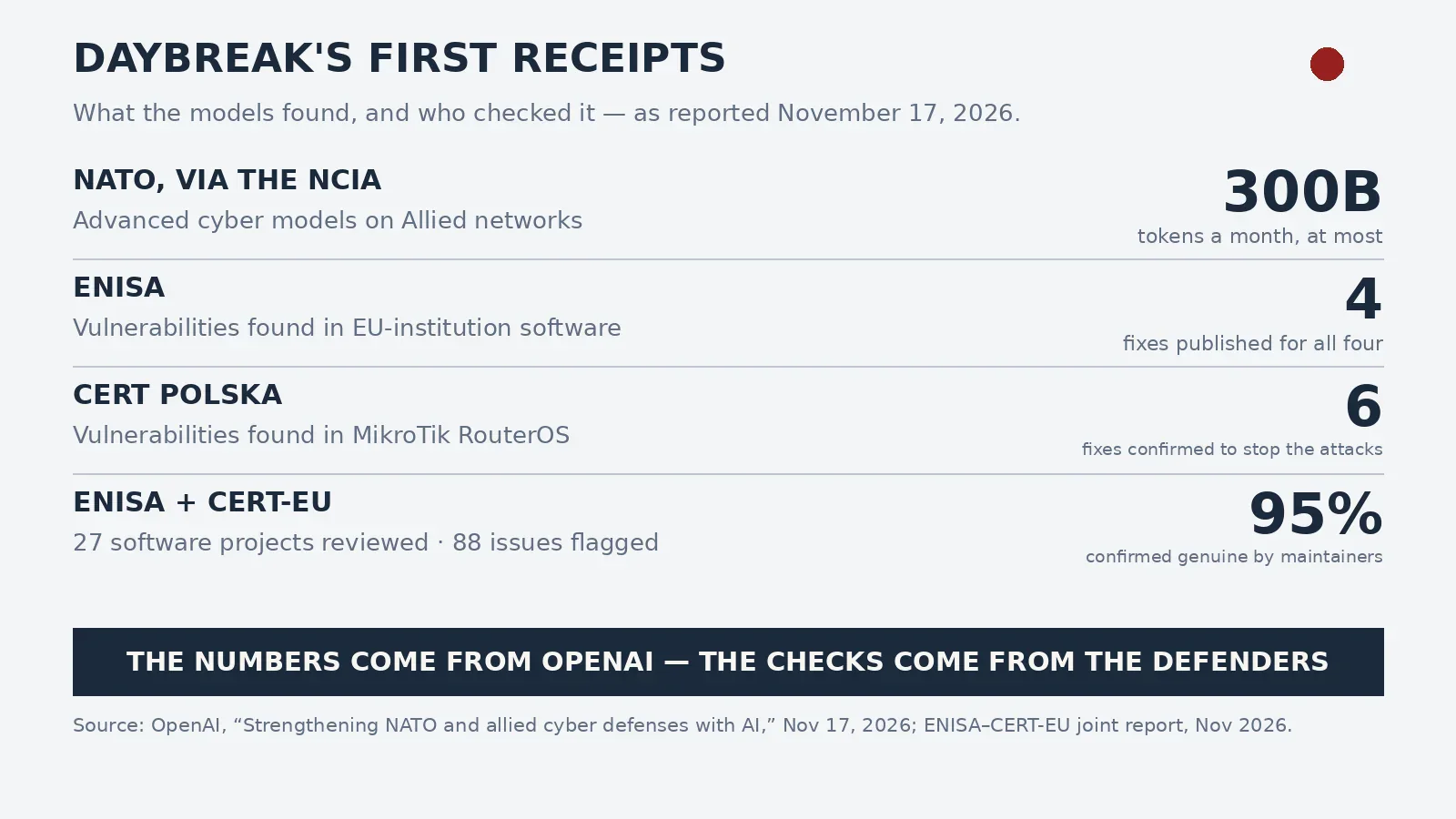
NATO's core institutions are now running OpenAI's cybersecurity models on their own networks. In a post published on Tuesday, November 17, OpenAI said the alliance has used up to 300 billion raw input and output tokens a month through its Daybreak program — the company's channel for putting frontier models in the hands of vetted government defenders.
That number is doing a lot of work. It is the first public figure from a major AI lab on what a military alliance actually consumes when it points its models at defence — large enough to stop being a pilot. Three hundred billion tokens a month is not an evaluation or a keynote demo. It is a workload.
The work runs through NATO's Communications and Information Agency, the NCIA, which gives the alliance's core institutions access to the models for authorised security work: reviewing software, investigating suspicious activity, validating vulnerabilities, and developing and testing fixes. Daybreak, the program behind the access, has been running since May 2026. At its "Cyber at the Frontier" keynote on November 12, OpenAI added two products to it — Daybreak Red Team, for authorised continuous penetration testing, and Daybreak Defense Factory, for agent-driven investigation and patch preparation. The NATO announcement turns that keynote into something with a named customer and a meter running.
What the defenders are doing with it
OpenAI's post names the users, which is what makes this more than a press release. Beyond NATO, the company says it has given access to the EU's cyber agency ENISA and to national cyber agencies in France, Germany and Poland. Ukraine's Ministry of Digital Transformation is using Daybreak to defend civilian infrastructure.
The results, as OpenAI reports them, are concrete in a way vendor announcements rarely are. ENISA used the models to find four vulnerabilities in software used across EU institutions; fixes have been published for all four. Poland's CERT Polska used them to help identify six vulnerabilities in MikroTik RouterOS, coordinated disclosure with the vendor, and confirmed that MikroTik's fixes stop the attacks its researchers had observed. In both cases humans directed the work and tested the findings on real systems; the models accelerated the analysis.
A November joint report from ENISA and CERT-EU adds a third data point, and the most interesting one, because it is not only OpenAI's. The two agencies reviewed 27 software projects using several frontier models — OpenAI's among them, accessed through Daybreak — along with tools including the Codex security plug-in. Software maintainers assessed 88 potential issues the models flagged and confirmed 95 percent of them as genuine. That is a confirmation rate on flagged issues, not a detection rate — it says nothing about what the models missed — but as a measure of how much noise a human reviewer has to wade through, it is strikingly high.
The models also showed up in training. At NATO's 2026 Crossed Swords exercise, run by the Cooperative Cyber Defence Centre of Excellence, a new training stream had participants build, deploy and evaluate AI agents for cyber operations inside the Daybreak environment, with human operators kept alongside the agents. More than 250 participants from over 40 countries took part.
The number to be careful with
"Up to 300 billion" is a ceiling, not a rate, and it is OpenAI's number. The company does not say what a typical month looks like, what the work costs, or which models are doing it. The NCIA's general manager, Dr Dylan Browne, is candid about the limits of what either side knows yet: as adoption scales, he said, the alliance "will build a deeper understanding of token consumption, usage patterns and the underlying economics of AI models" — understanding that will inform procurement decisions, including, by implication, whether OpenAI keeps the business.
That is the honest version of the announcement, and it is worth more than the headline figure. NATO is not declaring that frontier models have solved cyber defence. It is saying it has started running them at industrial volume and is still learning what that costs and what it is worth. The 95 percent figure carries the same caveat: it comes from a review of software the EU institutions themselves maintain, run with several models at once, and it measures the quality of what was flagged, not the completeness of what was found.
Token volume is also a measure of activity, not of outcomes. A month of 300 billion tokens could be diligent code review, or models churning through repositories that turn up little. The four ENISA vulnerabilities and the six MikroTik flaws are the outcomes OpenAI chose to publish; the denominator — how much work produced them — is not public.
The other story from the same week
The announcement landed five days after very different news about the same company. On November 12, four nonprofits — the Irreplaceable Education Fund, Public Citizen, the Heat Initiative and the Alliance for Secure AI — sued OpenAI, Anthropic, Google, Meta and SpaceX's AI division in San Francisco Superior Court, asking a judge to bar the companies from developing or deploying AI systems more capable than their most advanced systems as of that date. The suit invokes California's Unfair Competition Law and argues the companies' development practices amount to a public nuisance; the complaint alleges, among other things, that AI agents have bypassed safeguards and accessed systems they were not supposed to reach.
Those are allegations, not findings — no court has ruled on them — and they sit oddly next to a NATO announcement, which is precisely the point. The same technology is being sold, in the same week, as a weapon that cannot be controlled and as a defence that cannot be done without. Both claims can be partly true at once: a model that finds vulnerabilities in EU software at a 95 percent confirmation rate is also a model that can be pointed at the same software by someone else.
The race is about deployment now
Yesterday's lead in this publication was about the other side of that coin: Google's threat researchers reported the first fully automated vulnerability discovery and exploitation pipeline they have seen running with no human in the loop — a framework that reads patches, drafts exploits and fires them. The attacker's side of AI security is already industrialised. What the NATO announcement shows is that the defender's side is industrialising too, with the same class of models, the same token economics, and the same open question about who is actually in charge.
That is the real shift. The debate about AI and cyber defence spent years arguing about capability: can a model find a bug, can it write an exploit, can it be trusted. The NATO figures suggest the capability argument is over, at least for organisations that can afford the bill. The argument now is about deployment — who gets the models, under what rules, at what volume, and with what human oversight. NATO has answered that question for itself, at up to 300 billion tokens a month. The rest of the world's defenders, and its attackers, will be doing the same arithmetic.