Anthropic goes public: $33 billion of revenue, a $900 billion compute bill
The first AI lab lists on Nasdaq at $70–$78 a share, with orders reportedly six times the shares on offer. The filing tells two stories: the fastest revenue growth in history, and $900.9 billion of promised compute spending.

On this page
In brief
- Anthropic will sell 825 million shares at $70–$78, listing as ANT on Nasdaq; pricing is expected November 18, trading November 19.
- Revenue grew from $41 million in 2023 to $33.2 billion in the first nine months of 2026; run-rate revenue reached about $81 billion on October 31.
- The filing discloses about $900.9 billion in compute and infrastructure commitments, with $70.7 billion due within a year — against mostly month-to-month revenue.
- Seven suppliers — Google, Nvidia, AMD, Broadcom, Micron, Microsoft, TSMC — will buy $26 billion of stock in a concurrent private placement.
- Governance keeps control with the founders: a Class F share carries 50.1% of votes, and the Long-Term Benefit Trust elects a board majority.
Anthropic is about to become the first AI lab to trade on a public market, and the paperwork reads like two different companies stapled together. One of them has the fastest revenue growth in corporate history. The other has signed up to spend $900.9 billion on computing power.
The terms, set out in an amended prospectus filed with the SEC on November 10, are simple enough: 825 million shares at $70 to $78 each, listing on Nasdaq under the ticker ANT, with pricing expected on November 18 and trading to begin the following day. At the top of the range the sale would raise up to $64.35 billion — the largest IPO ever by money raised. The hard part is deciding what the buyer is actually buying.
The fastest growth in the filing cabinet
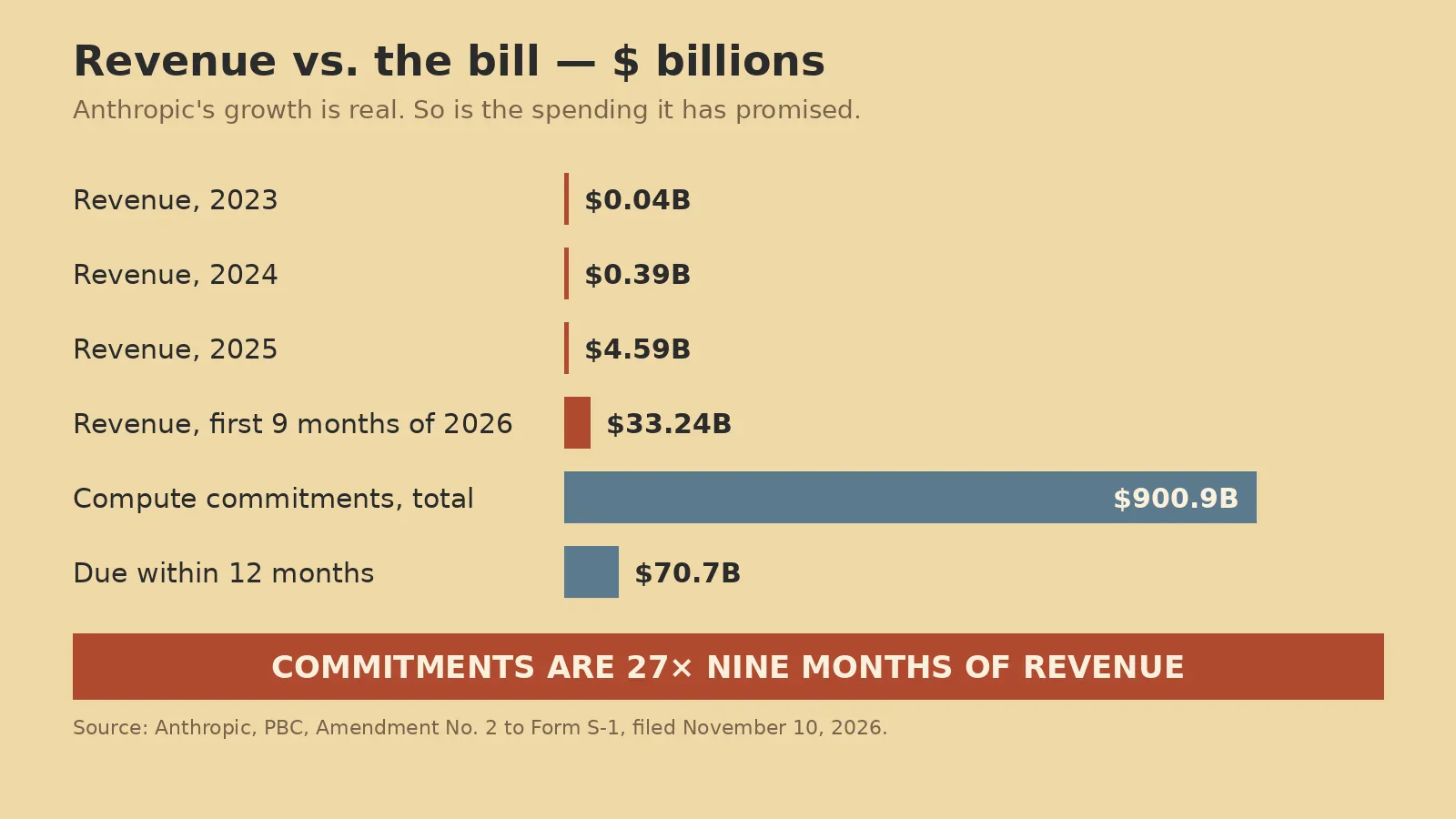
Anthropic's revenue was $41 million in 2023, $386 million in 2024, and $4.585 billion in 2025. In the first nine months of 2026 it took in $33.242 billion — thirteen times the same stretch a year earlier — including $17.0 billion in the third quarter alone. The company calls it "the fastest enterprise adoption of any technology in history," and the numbers make the boast hard to dismiss. Run-rate revenue, which annualises the last 28 days of usage fees plus subscriptions, stood at about $81 billion on October 31, up $10 billion in a single month.
The losses, read carefully, are less alarming than the headline figure. The operating loss for the nine months was $1.26 billion, down from $5.22 billion a year earlier. The $104.0 billion net loss is dominated by a $94.3 billion change in the fair value of convertible notes and similar instruments — an accounting remeasurement as those notes convert, not cash walking out the door. Adjusted operating income, a non-GAAP measure, was $4.08 billion for the same nine months.
The other number on page seven
Then there is the bill. As of September 30, Anthropic had entered purchase commitments and leases "with an aggregate committed spend of approximately $900.9 billion, substantially all of which is related to compute and infrastructure." About $451.6 billion is expected to be incurred before the end of 2030; about $70.7 billion falls due in the twelve months after September 30. The schedule runs to 2045, and about $186 billion of the total can be terminated or depends on conditions counterparties must first meet — the rest, mostly, cannot.
The filing is unusually blunt about the mismatch this creates: "our revenue is primarily consumption-based, and much of it is not subject to long-term contractual commitments, while our compute and infrastructure commitments generally extend over multiple years." Anthropic has promised to pay for years of computing power with revenue that arrives month to month, from customers who can leave. Many of the agreements are take-or-pay: the company pays whether it uses the capacity or not.
The third quarter shows the cost line moving faster than the revenue line. Compute and infrastructure expense rose 77% from the second quarter to the third, from $5.56 billion to $9.86 billion, while revenue rose 47%, from $11.56 billion to $16.96 billion. Compute was 58% of revenue in the quarter, up from 48% the quarter before. The filing also admits Anthropic has "significantly underestimated" its compute requirements before, and that it bought $5.0 billion of compute in the third quarter under short-term commitments, at significantly higher cost than multi-year contracts.
None of this means the company is about to run out of money. It held about $132 billion in cash and short-term investments at the end of September, and the offering plus a concurrent private placement should add roughly $85 billion at the midpoint of the price range. The question is whether the spending converts into revenue that keeps compounding faster than the bills come due.
The suppliers are also the shareholders
Seven of the companies Anthropic owes that money to are also buying the stock. AMD, Broadcom, Google, Micron, Microsoft, Nvidia, and TSMC have agreed to buy $26.0 billion of non-voting Class N shares in a private placement at the IPO price, closing immediately after the offering. The arrangement is circular in a way worth noticing: the vendors selling Anthropic its computing power are also financing the raise that pays for it.
Who actually gets to buy in
Bloomberg reported on November 12, citing people familiar with the matter, that orders had reached about six times the shares on offer, with bankers telling investors that existing backers would get priority. The Financial Times reported a day earlier that bankers were weighing pricing the deal above the $70-to-$78 range, which would lift the valuation toward $1.5 trillion.
Ordinary investors get an unusually large look-in. The filing says Anthropic expects up to 20% of the Class A shares to go to retail investors in the US and other countries, roughly double the 5% to 10% typical of large US listings, sold through Schwab, Fidelity, Robinhood, TradePMR, SoFi, and E*Trade. But 20% of an offering six times oversubscribed still leaves most retail requests filled in part or not at all.
Not everyone is being let in. Bloomberg reported on November 13 that institutional investors based in mainland China and Hong Kong were being turned away, with some banks citing US arms-export rules. Anthropic declined to comment on the report. The lockup is staggered: directors, officers, and non-founder employees can sell up to 10% of their holdings once trading starts.
A company designed not to be taken over
Public shareholders should understand what they are not buying: control. Anthropic is a Delaware public benefit corporation, and its governance is built to keep the mission — "the responsible development and maintenance of advanced AI for the long-term benefit of humanity" — ahead of the share price. A single Class F share, issued to a company owned by the seven co-founders, carries votes equal to 50.1% of the total voting power, and the Long-Term Benefit Trust, an independent body of trustees, elects a majority of the board. Employees get Class E shares that vote only on limited matters and carry no economic rights. The public gets Class A shares: economics, one vote each, and no say in the structure above them. That is the point of the design, not a flaw in it — but it is a design buyers should read before they buy.
What the price will test
At the top of the range, Reuters puts the fully diluted valuation at up to about $1.4 trillion — roughly 17 times the $81 billion run-rate, in line with software names like Snowflake and Datadog, except those companies are not carrying $900.9 billion of future spending. The run-rate is an estimate, annualised from 28 days of usage, and the registration is not yet effective: the price, the share count, and the timetable can still change.
So the IPO is a bet with unusually clear terms: the fastest-growing revenue line ever filed, a cost line growing faster still, a $900.9 billion promise to its suppliers, and governance that answers to founders and trustees before shareholders. The order book says the market wants in anyway. On Thursday, it gets to name its price.