The FAA grounded every flight and Microsoft 365 went dark — neither was a cyberattack
Within thirty hours, a flood of connection attempts grounded every U.S. departure and a network upgrade took down Microsoft 365. Officials say the two failures are unrelated — and neither was an attack.
On this page
In brief
- A flood of 1,000 connection attempts every 4–5 seconds destabilised the FAA's legacy telecom network, grounding every U.S. departure for just over four hours on November 13.
- About 12,462 flights were cancelled; roughly 3,500 aircraft already airborne landed safely, and no one was hurt.
- Microsoft 365 went dark worldwide the day before, starting at 1:26 p.m. ET on November 12, and was not fully restored until Saturday, November 14.
- Officials say the two failures are unrelated and neither was a cyberattack — the FAA ruled out its new AI planning tool SMART, and Microsoft ruled out cyber and AI agents.
- Both failures were self-inflicted in the mundane sense: a router deployment and a network capacity upgrade meeting ageing infrastructure.
Friday afternoon, the United States stopped flying. At 3:54 p.m. Eastern on November 13, the Federal Aviation Administration ordered a nationwide ground stop — every airport in the country, every departure held. About 3,500 aircraft were already in the air; every one landed safely. The stop lasted just over four hours; by the time the FAA lifted it at 8:15 p.m., airlines had cancelled about 12,462 flights.
It was only the third nationwide ground stop in American history, after September 11, 2001, and the January 2023 failure of the FAA's Notice to Air Missions system. This one was different from both: no attack, no single system failure — a flood of data the country's air traffic network could not absorb.
And it was the second act of a very bad thirty hours. The day before, Microsoft 365 had gone dark around the world — Outlook, Teams, Copilot, SharePoint, Defender XDR — the whole productivity stack, unreachable for millions, starting Thursday afternoon. It was not fully restored until Saturday.
Two of the most depended-on systems in the Western economy failed within a day and a half, and the first question everyone asked was whether they were connected — and whether someone had done it on purpose. Federal officials answered both, twice over, in unusually plain language. No. And no.
What grounded the planes
The FAA's own account, published after the stop was lifted, is precise about what happened and careful about what it does not yet know. The agency's legacy equipment became unstable when data began flooding its telecommunications network, the FAA Telecommunications Infrastructure (FTI), at 1,000 connection attempts every four to five seconds. The flood disrupted aircraft communications and radar feeds at 17 of the FAA's 22 Air Route Traffic Control Centers, spreading into several terminal radar facilities.
The initial investigation points to two locations: a radar site in Amarillo, Texas, and a radio communications site in El Dorado, Arkansas, where L3Harris, the FAA's network service provider, had been deploying a new router. L3Harris blocked both locations and the network stabilised. The broadcasting function was switched off on all the new routers — and on about 60 similar routers across the system, the FAA says.
Transportation Secretary Sean Duffy put it in blunter terms at an evening news conference. Aging switches and routers "got overloaded with data" and began producing inconsistent information. The agency, he said, still relies on "1980s little copper lines." The new equipment held: "Our new IP switches did not go down. It's the old hardware that went down."
Homeland Security Secretary Markwayne Mullin said the overload appeared to have been triggered by new equipment the FAA was installing, which "was overwhelming the older system."
The FAA was categorical on both questions. "Based on all available evidence, we have no indication that this was a cyberattack or an outside nefarious actor." And the failure was not caused by SMART, the FAA's new AI traffic-planning tool, expanded to all 22 en route centers earlier that week. SMART is a data aggregator, the FAA said, not a feed into air traffic control. Duffy was equally direct: "There was no possible way SMART would have impacted what happened today."
What took down Microsoft 365
The Microsoft outage began on Thursday, November 12, at 1:26 p.m. Eastern, tracked as MO1550821. Microsoft confirmed customers might be unable to connect to Exchange Online, Teams, SharePoint Online, Microsoft 365 Copilot, and Defender XDR.
The company's explanation was a capacity problem, not a demand problem. Servers were unexpectedly becoming unavailable, and a core process on the affected servers — the one that establishes secure connections — was becoming overwhelmed, straining the servers that remained. Microsoft paused all deployments, redistributed traffic, and restarted affected servers. Recovery came slowly, in stages: services were still being restored on Friday morning, more than 18 hours in.
By Saturday, Microsoft said service was fully restored and gave its final word on the cause, quoted by the Associated Press and WIRED: "this was a technical issue not related to cyber or AI/agents. The incident was introduced by an issue during an earlier network capacity upgrade that surfaced following a recent network change." A full post-incident report is promised; until it appears, that sentence is the whole public account. Downdetector received user outage reports from 70-plus countries and territories, the AP reported — reports of trouble, not a count of affected users.
The pattern is the story
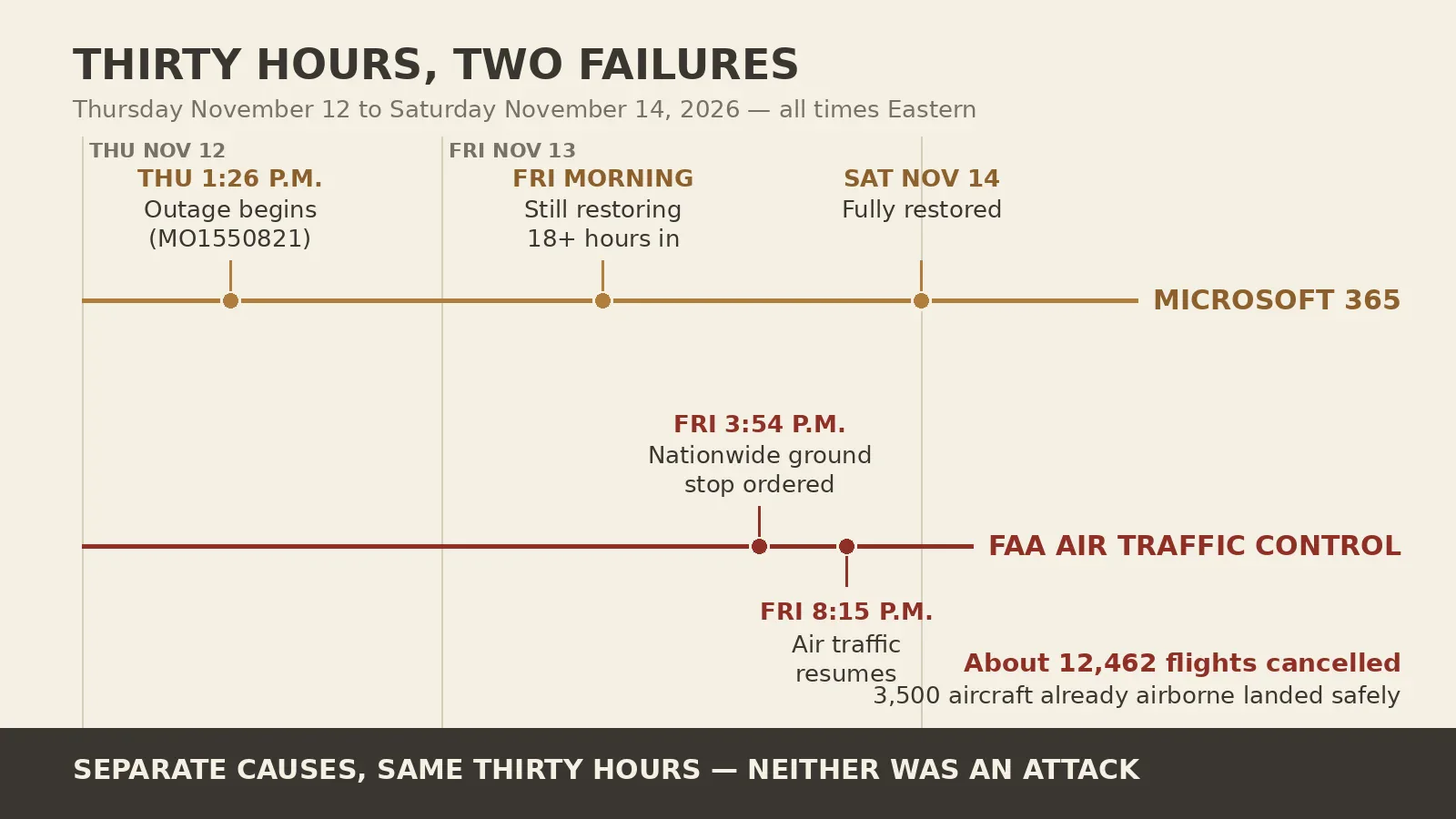
Strip away the specifics and the two incidents rhyme. Neither was an attack. Neither was a traffic surge. Both were the system's own changes meeting its own age: a router deployment in Arkansas that flooded a legacy network; a capacity upgrade whose consequences surfaced only after a later change. In both cases the fix was operational and unglamorous — block two locations, switch off a function on about sixty routers; freeze deployments, move traffic, restart servers one batch at a time.
That is also why both organisations spent their briefings ruling out dramatic explanations. The FAA had to say its new AI planning tool had nothing to do with it — the timing made the question fair, since SMART had reached all 22 en route centers the same week. Microsoft had to say its outage was "not related to cyber or AI/agents." The boring cause did the damage in both cases — and it is the one nobody had a press conference ready for.
There is a real argument underneath the reassurance. The FAA says none of the towers upgraded under its modernisation programme went down — the new gear held, the old gear failed. But the new gear is also what overloaded the old gear, by the administration's account. The agency is replacing its legacy telecom network with a modern IP network; AT&T took the lead role in August on a $74.3 million award, aiming to finish by the end of 2028. The administration has asked Congress for $30.1 billion more for aviation infrastructure; Duffy wants $50 billion. A Government Accountability Office review has previously found more than 100 of the FAA's 138 air traffic control systems inadequate or unsustainable. The ground stop demonstrates what that means in practice.
What to take from a bad weekend
The reassuring part is real. Safety procedures worked as designed: controllers kept talking to pilots on the frequencies that stayed up, every aircraft landed, no one was hurt. The ground stop was a choice, made out of caution, not a collapse.
The uncomfortable part is real too. The country's air traffic system can be grounded for an afternoon by work at a radio site in Arkansas; the world's largest productivity suite can go dark for more than a day because of a capacity upgrade. Both will recur in some form, because the systems they happened to are old, large, and under constant change.
The lesson is not that anyone should have predicted these two failures. It is that the failure mode to plan for is rarely the one in the threat model. Nobody attacked the FAA's network and nobody attacked Microsoft's. A router did it. An upgrade did it. The next one will be just as ordinary — and just as disruptive.